
How Wellness Got a Public Face
Over the past decade, self-care has migrated from private habit to public performance. Aesthetic morning routines, color-coordinated supplement stacks, and guided meditation screenshots have become a recognizable genre of social content. This shift reflects something real: health has become a marker of identity and status, not just a personal concern.
Platform design plays a significant role. Algorithmic feeds reward content that generates strong engagement, and aspirational wellness imagery - the smoothie bowl, the cold plunge, the gratitude journal - performs reliably well. As researchers studying digital media have noted, what circulates online is shaped by what gets clicks, not necessarily what reflects lived experience accurately.
The result is an environment where the appearance of wellness and wellness itself can quietly diverge. That gap - between looking after yourself and looking like you're looking after yourself - is worth examining carefully.
Defining the Two Approaches
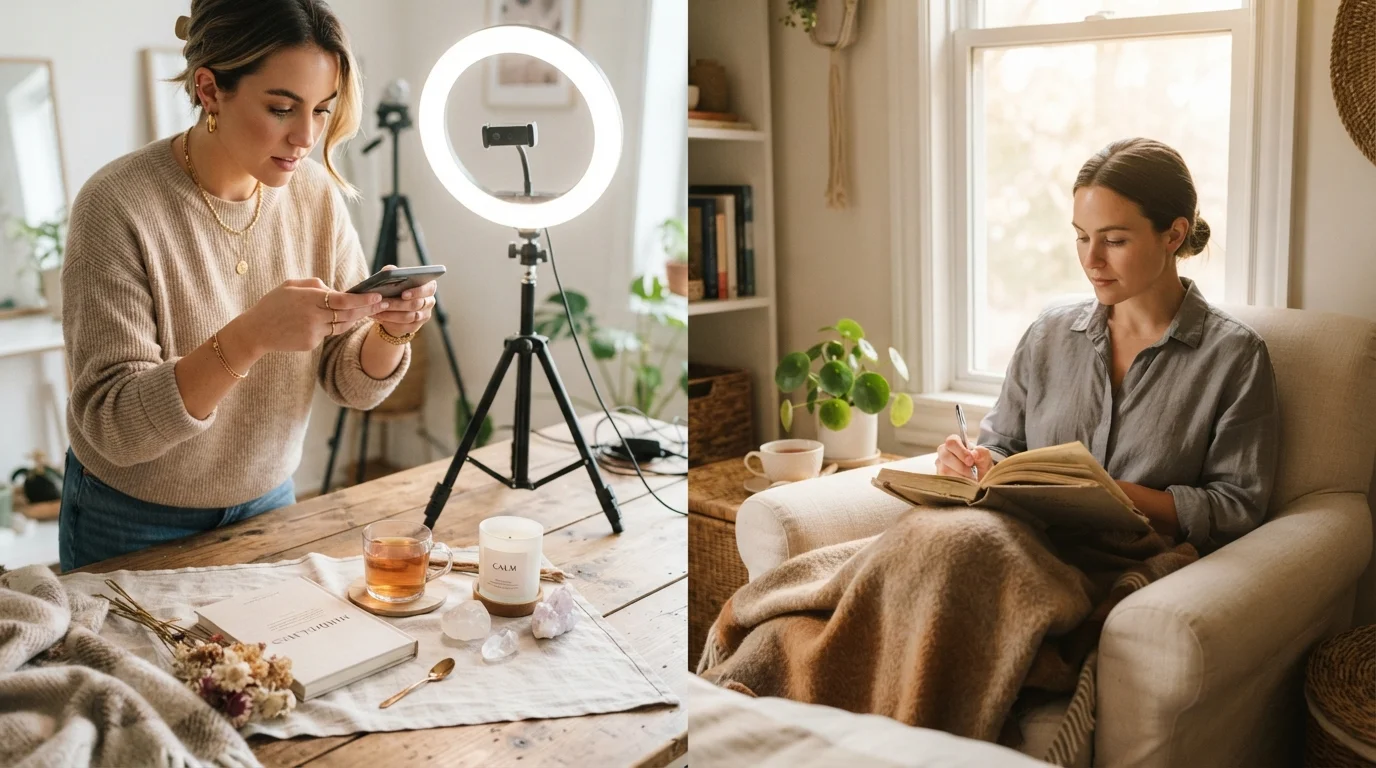
Performative wellness refers to health behaviors that are structured, at least in part, around social visibility. This isn't always cynical - people genuinely enjoy sharing routines, and external accountability can support real change. But when the behavior is sustained primarily by audience approval rather than personal benefit, the underlying purpose shifts. The practice becomes about the image of health rather than the experience of it.
Genuine self-care, by contrast, is responsive. It looks different from person to person and moment to moment because it's driven by what an individual actually needs: more sleep, a difficult conversation, professional mental health support, or simply permission to rest without productivity attached. It rarely photographs well. Understanding the core concepts of mental wellness - stress, mood regulation, resilience - helps clarify what self-care is actually meant to support.
| Criterion | Performative Wellness | Genuine Self-Care |
|---|---|---|
| Primary motivation | Social visibility and approval | Internal need and personal benefit |
| Consistency driver | Audience engagement | Personal relevance |
| Appearance | Curated, aesthetic, shareable | Often private and unpolished |
| Adaptability | Follows trends and formats | Responds to individual need |
| Outcome focus | Image of health | Experience of wellbeing |
| Risk | Comparison, anxiety, performative burnout | May lack community accountability |
Psychology research on motivation draws a related distinction between intrinsic motivation (doing something because it is personally meaningful or satisfying) and extrinsic motivation (doing it for external reward or social approval). Studies in the self-determination theory tradition consistently find that intrinsically motivated health behaviors are more durable and more strongly linked to wellbeing outcomes.
Warning Signs and Overlaps
The distinction isn't always clean. Posting about a therapy session can both process genuine emotion and perform vulnerability for an audience. A structured morning routine can serve real psychological needs while also being aesthetically documented. The question worth asking isn't "Is anyone watching?" but "Would I do this if no one were?"
46%
Adults reporting social media worsens body image
A 2023 survey by the American Psychological Association found nearly half of adult respondents felt social media made them feel worse about their own health habits.
3x
Higher burnout risk linked to extrinsic health goals
Research in the self-determination theory tradition suggests individuals pursuing health behaviors for primarily external reasons show significantly higher rates of dropout and emotional exhaustion.
Some patterns, however, signal that performance has overtaken function. These include: abandoning practices when they stop generating engagement; feeling anxious rather than restored after a wellness activity; spending more time curating the record of a habit than doing it; and comparing your private wellbeing unfavorably to others' public routines. That last pattern is closely linked to what researchers describe as social comparison - a mechanism feeding broader cultural burnout in overworked populations.
Genuine self-care, meanwhile, is characterized by its irregularity and privacy. It adapts. Some weeks it looks like exercise; others it looks like canceling plans to sleep. Small, sustainable habits linked to emotional steadiness tend not to be dramatic - which is precisely why they don't go viral.
This article is for general informational and educational purposes only and does not constitute medical or psychological advice. If you are experiencing significant mental health difficulties, please consult a qualified healthcare professional.