

The Term's Origins and What It's Actually Pointing At
"Chronically online" didn't emerge from academic research or journalism. It grew from the internet itself - a piece of communal self-diagnosis that spread on platforms like Twitter and Tumblr in the early 2010s. Users deployed it to describe people whose opinions, humor, or anxieties seemed so shaped by niche digital culture that they had lost touch with how most people think and talk.
The key distinction worth making early: the phrase is not a synonym for "uses the internet a lot." It describes a qualitative shift in perspective. A person who is chronically online has internalized the logic, vocabulary, and moral frameworks of specific online communities so thoroughly that those frameworks feel universal - even when they aren't. This is part of what makes it a cultural critique rather than a usage metric.
Understanding this term fits within the broader vocabulary of how people describe modern life. It sits alongside concepts like terms like "quiet quitting" and "main character energy" - shorthand that captures something real about a shifting social reality, even if the shorthand itself gets overused.
A Note on How the Term Gets Used
Like many pieces of internet slang, "chronically online" can be wielded selectively - sometimes to dismiss legitimate concerns, sometimes as genuine self-criticism, sometimes as an in-group signal. Understanding its origins as a form of communal self-awareness helps separate its descriptive uses from its rhetorical ones. The concept is most useful when applied analytically, not as an insult.
What the Research Says About Deep Digital Immersion
While "chronically online" is a colloquial label, the patterns it describes have a documented basis. Studies on heavy social media use - particularly platforms optimized for engagement through outrage and novelty - consistently find that prolonged immersion can distort users' sense of how common or extreme certain views actually are.
A well-documented dynamic is the "availability heuristic" at work online: if something appears constantly in a feed, the brain treats it as more prevalent or significant than it is. Heavy platform users tend to overestimate how much the general public cares about the specific debates dominating their feeds. This is part of what the "chronically online" label is gesturing at - a miscalibrated sense of what matters and to whom.
72%
U.S. adults who use social media regularly
According to Pew Research Center surveys, roughly seven in ten U.S. adults use at least one social media platform, making platform immersion a near-universal experience even if intensity varies.
6+ hours
Daily screen time reported by heavy users
Global Digital Reports from DataReportal consistently show that a significant share of internet users spend six or more hours daily on connected devices, with social media accounting for a substantial portion.
3x
Overestimation of outrage online vs. offline
Research published in journals on political psychology has found that social media users frequently overestimate how angry or extreme general public opinion is compared to what surveys of the broader population reveal.
This has real social consequences. Online communities often fragment precisely because internal discourse becomes self-referential and legible only to insiders, pushing out people with less immersive engagement.
Online vs. Offline Reality: Where the Gap Widens
One of the most consistent observations about chronically online behavior is the gap it creates between digital and physical social reality. Inside heavily immersed communities, certain terms, references, and conflicts are treated as universally known. Outside them, most people have never heard of the issue at all.
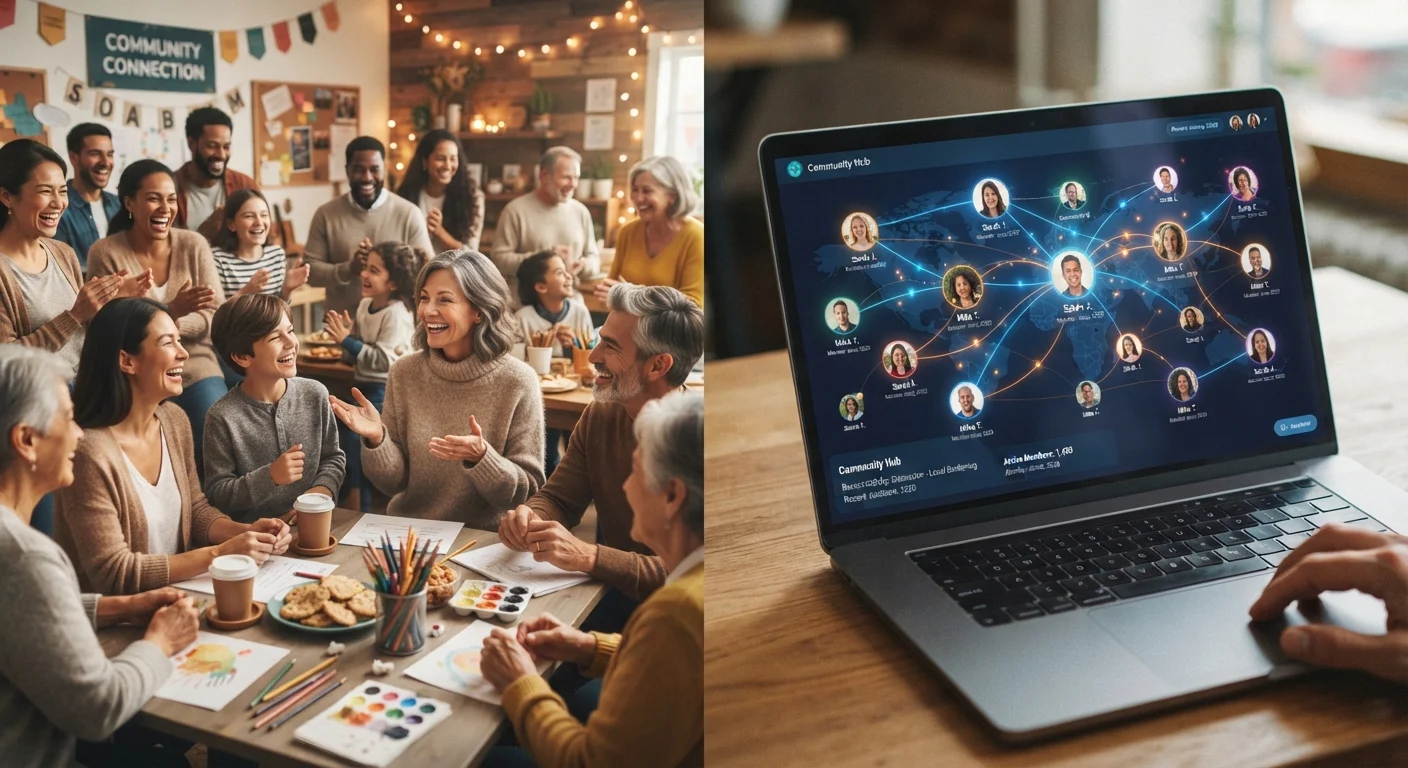
This disconnect matters for how we understand the structural differences between online and in-person communities. Physical communities share geography, embodied cues, and the friction of proximity. Online communities can become echo chambers more easily, and immersion can accelerate the gap between internal norms and outside reality.
It's worth noting that the label itself is sometimes used reductively - as a way to dismiss legitimate concerns raised online, or to frame any fluency with internet culture as pathological. Used carefully, though, it identifies something real: a perceptual skew that shapes what people think, fear, and find funny.
Calibrate Your Feed Against Offline Reality
A practical way to check for chronically online drift is to periodically describe an online debate to someone with little social media use and observe their reaction. If the concern reads as obscure or disproportionate to them, that gap is worth examining. This isn't about dismissing digital discourse - it's about maintaining perspective on which online dynamics reflect broader social reality and which are amplified inside specific platforms.
Why This Concept Matters Beyond the Meme
The reason "chronically online" has staying power as a concept is that it points to something measurable about how media environments shape cognition and social behavior. Media scholars have described similar dynamics through terms like "filter bubbles" and "context collapse" - the breakdown in shared meaning when content created for one audience reaches another unprepared for it.
For everyday readers, the concept is most useful as a calibration tool. Asking whether a heated online debate maps onto anything most people actually experience offline is a form of media literacy. It doesn't mean online concerns are automatically invalid - many start online and become mainstream - but it does mean treating digital discourse as a complete picture of social reality carries genuine risk.
Thinking critically about your own digital environment connects to broader questions about how information ecosystems shape what we believe about the online world. The same immersive dynamics that make someone chronically online also make it easier to internalize misinformation or assume that common online claims reflect established fact.
“The internet doesn't just reflect culture - it actively produces new norms, new hierarchies, and new anxieties that then feed back into how people see the world. The challenge is knowing when you're inside that feedback loop.”
— danah boyd, Principal Researcher at Microsoft Research and founder of Data & Society