

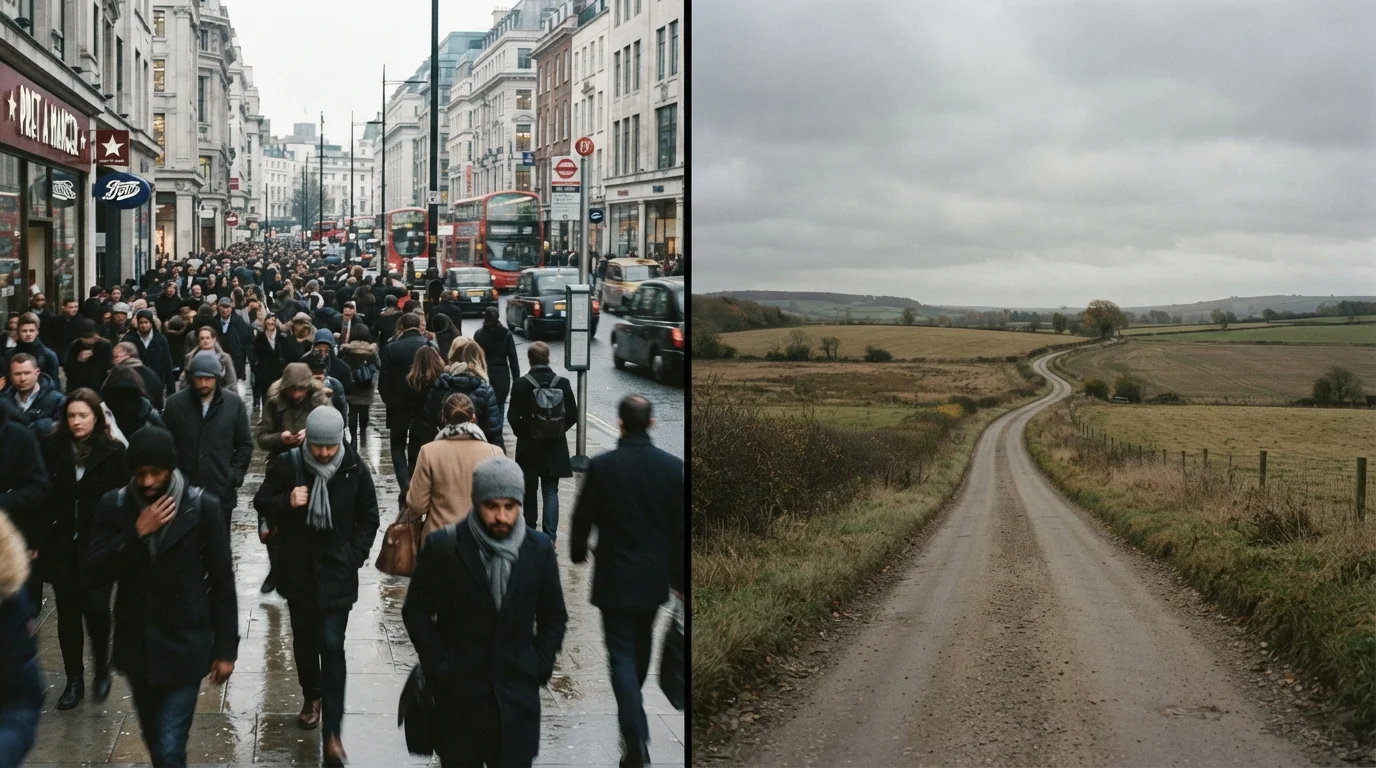
The Core Distinction: Proximity Without Connection vs. Distance Without Support
Loneliness and isolation are often treated as the same problem, but geography shapes them into two distinct experiences. As researchers at the distinction between solitude and loneliness have noted, the emotional state of loneliness is not simply the absence of people - it is the perceived absence of meaningful connection.
In cities, people are rarely physically alone. Rush-hour commuters, open-plan offices, and dense apartment blocks place individuals in constant proximity to others. Yet that proximity rarely translates into genuine social bonds. Interactions are often transactional - a barista, a delivery notification, a nod in a corridor. Sociologists describe this as a surfeit of weak ties and a scarcity of strong ties: the deeper relationships that buffer against loneliness.
Rural isolation operates on a different axis. The problem is not anonymous crowds but the structural absence of people and services. In sparsely populated areas, the nearest neighbor may be miles away, public transport limited or nonexistent, and institutions like libraries, clinics, or community centers increasingly scarce as consolidation shrinks the public footprint in low-density regions.
| Criterion | Urban Loneliness | Rural Isolation |
|---|---|---|
| Primary cause | Weak social ties despite physical proximity | Geographic distance and lack of services |
| Most affected group | Young adults (20s-30s) | Older adults in shrinking communities |
| Nature of the problem | Relational - absence of meaningful bonds | Structural - absence of people and infrastructure |
| Visibility | Hidden in plain sight among crowds | Visibly sparse, but often overlooked by policy |
| Digital connectivity impact | Moderate; supplements but doesn't replace bonds | Higher impact; reduces informational isolation |
| Healthcare access barrier | Stigma and affordability | Distance and provider scarcity |
| Key intervention type | Social programming, interest-based groups | Transport, broadband, mobile services |
Who Is Most Affected - and Why It Differs
The demographics of each experience are strikingly different. Urban loneliness disproportionately affects young adults. Surveys across several high-income countries have consistently found that people in their 20s and 30s - despite living in the most connected cities - report some of the highest rates of loneliness. This counterintuitive finding is partly explained by the social expectations city life carries: high mobility, frequent job changes, and less stable neighborhood ties make it harder to sustain the slow accumulation of trust that deep friendships require.
Rural isolation, by contrast, tends to weigh most heavily on older adults. As rural communities age - younger generations leaving for urban job markets - those who remain face dwindling peer networks, reduced driving ability, and greater physical distance from family. The geographic community that once organized rural social life has, in many regions, fragmented significantly.
1 in 4
Adults reporting chronic loneliness in high-income countries
A 2023 meta-analysis published in PLOS ONE estimated that roughly one in four adults in high-income nations experiences frequent or persistent loneliness.
~17%
EU population living in rural or sparsely populated areas
According to Eurostat data, approximately 17% of the EU population resides in sparsely populated rural areas, where service access is structurally limited.
26%
Increased mortality risk linked to social isolation
Research published in Perspectives on Psychological Science estimated a 26% increase in mortality risk associated with social isolation, comparable to other major health risk factors.
It is also worth noting that both contexts carry compounding risk factors. In cities, high housing costs push people into overcrowded shared living or solitary micro-apartments with little communal space. In rural areas, economic precarity - linked to agricultural consolidation or deindustrialization - adds financial stress to social thinness.
What the Research Shows About Health Consequences
Both forms of disconnection carry measurable health consequences, though the pathways differ. A substantial body of research - including work associated with former U.S. Surgeon General Vivek Murthy and public health researchers in Europe - has linked chronic loneliness to elevated risks of cardiovascular disease, depression, and cognitive decline. The mechanism appears to involve sustained physiological stress: the body reads social disconnection as a threat, activating stress hormones over extended periods.
In rural contexts, health risks are compounded by reduced access to healthcare itself. Longer distances to clinics, fewer mental health practitioners per capita, and the cultural tendency in some rural communities to underreport psychological distress all mean that rural isolation may be more likely to go unaddressed. Urban loneliness, while surrounded by services in principle, carries its own barrier: stigma. Admitting loneliness in a city associated with opportunity and social abundance can feel like a personal failure, discouraging people from seeking support.
Loneliness and Mental Health: A Note on Seeking Help
This article discusses loneliness and social isolation as social and public health phenomena - it is not a substitute for professional mental health support. If feelings of isolation are persistent or significantly affecting your daily life, speaking with a qualified healthcare professional or counselor is recommended. In many countries, general practitioners can provide referrals to appropriate mental health services.
Different Causes, Different Solutions
Because the roots of urban loneliness and rural isolation differ, so do the responses that evidence suggests are most useful. Urban loneliness tends to respond to interventions that create repeated, low-pressure contact - the kind that allows relationships to build incrementally. Online communities can supplement social life but generally don't replicate the texture of in-person belonging. Interest-based groups, cooperative housing models, and neighborhood-scale programming have shown more promise in urban settings.
Rural isolation, by contrast, requires structural responses as much as social ones. Transport-to-community programs, mobile health and library services, and investment in local gathering spaces address the physical barriers that make connection difficult regardless of an individual's willingness to engage. Digital connectivity - broadband expansion in particular - has reduced informational isolation in rural areas and enabled remote work, though it cannot fully substitute for embodied social life.
For individuals navigating either experience, researchers suggest that the quality of a small number of close relationships matters more than the size of a social network. Those building a sense of belonging after a move or life transition - urban or rural - often find that consistent, low-stakes contact (a regular coffee, a weekly class) is a more reliable path to connection than grand social gestures.