

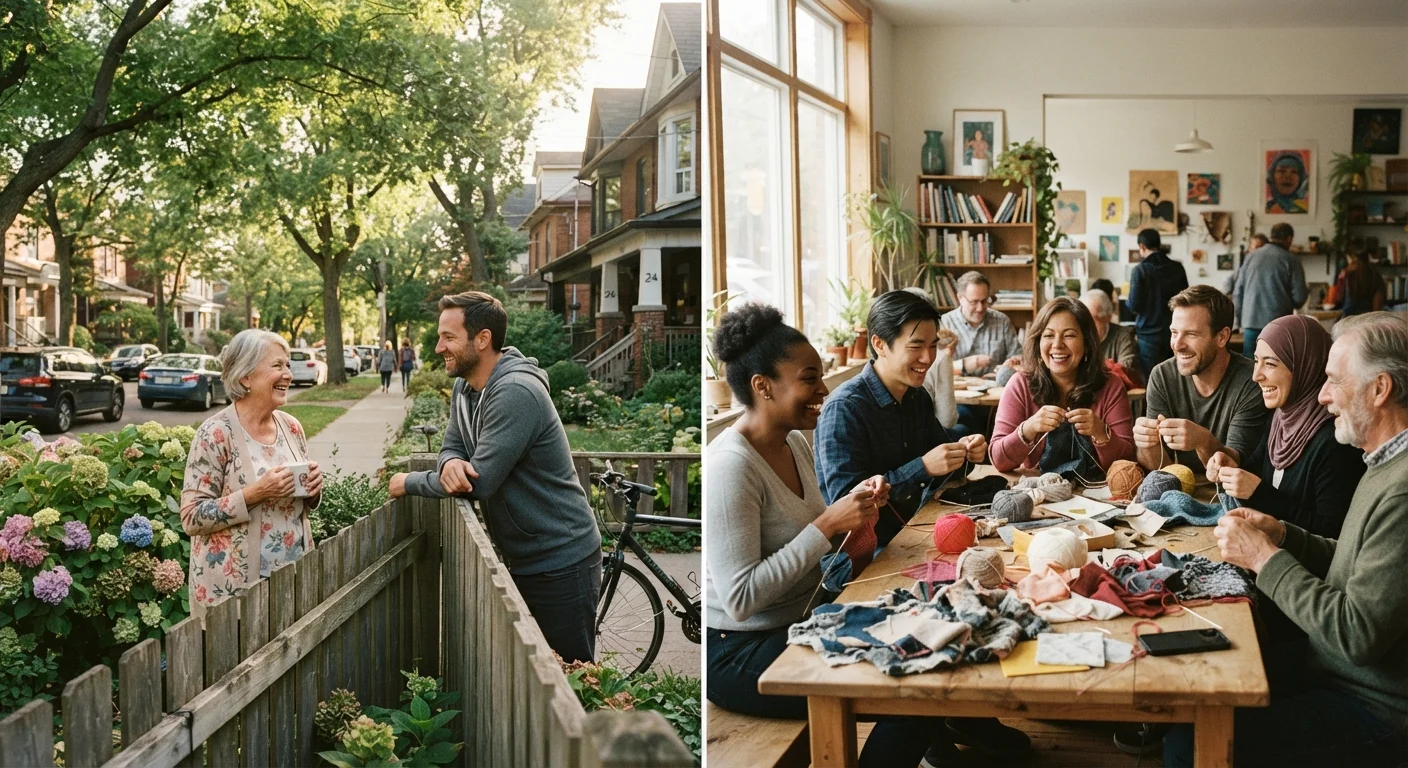
The Two Foundations of Community
Sociologists have long distinguished between two broad types of community: those organised around place, and those organised around shared purpose or identity. The distinction matters because these communities form differently, sustain themselves differently, and offer different things to their members.
A geographic community - a neighbourhood, village, or urban district - exists because people happen to live near one another. Membership is not chosen; it is inherited through circumstance. A community of interest, by contrast, forms when people actively seek out others who share a passion, belief, profession, or experience. For a fuller account of what transforms any group into a genuine community, see what makes a group of people a community.
How Geographic Communities Work
Place-based communities are held together by proximity, routine, and what sociologists call weak ties - the low-stakes, repeated interactions that accumulate into social trust over time. The neighbour who signs for your parcel, the local shopkeeper who knows your name: these are not deep friendships, but they constitute a form of social infrastructure that proves valuable during disruptions - illness, power cuts, flooding.
Research into social capital, associated with scholars such as Robert Putnam, suggests that dense neighbourhood networks correlate with measurable outcomes in health, civic participation, and even crime reduction. Yet geographic communities are also fragile in specific ways. They cannot guarantee ideological alignment, and they are increasingly undermined by residential mobility, urban anonymity, and the decline of third places - the cafés, parks, and community halls where casual interaction naturally occurs.
Proximity Alone Does Not Create Community
Living near others is a precondition, not a guarantee. Research consistently shows that high-density housing without shared spaces or opportunities for interaction produces co-presence without genuine community. Planners and residents alike often underestimate how much deliberate design - or deliberate effort - is required to turn neighbours into a functioning social network.
How Communities of Interest Work
Interest communities operate on a different logic. Members opt in, which means the baseline of shared motivation is already higher. Whether organised around a sport, a faith, a professional field, an illness, or a cultural identity, these groups generate what social identity theory describes as a powerful sense of collective self - a feeling of we that reinforces belonging. Shared identity acts as the invisible adhesive.
Interest communities can flourish at enormous geographic scale, particularly online. A knitting group, a chronic illness forum, or a diaspora network can connect people across continents who would never otherwise meet. That breadth, however, comes with its own fragility: without physical co-presence, sustaining engagement over time requires conscious effort. Online community-building frequently falters precisely because the structural supports that geographic communities take for granted - shared space, daily encounter - are absent.
Bridging Both Community Types
Interest communities that build in regular, place-based gatherings - even occasional in-person meetups - tend to sustain engagement longer than purely digital ones. Conversely, geographic communities benefit when residents create interest-based sub-groups (a local running club, a community garden) that give neighbours a reason to connect beyond mere proximity. Combining both structures often produces more resilient social bonds than either approach alone.
A Side-by-Side Comparison
The two community types differ across several practical dimensions. Neither is universally superior; context shapes which offers more value at a given moment in a person's life.
| Geographic Community | Community of Interest | |
|---|---|---|
| Basis of membership | Shared physical location | Shared passion, identity, or purpose |
| How members join | Circumstance (residence) | Active self-selection |
| Typical tie strength | Many weak ties | Fewer but stronger ties |
| Geographic reach | Local, bounded by place | Potentially global |
| Main vulnerability | Mobility, anonymity, urban sprawl | Engagement drop-off, fragmentation |
| Primary benefit | Practical mutual aid, social safety net | Deep belonging, shared identity |
Both forms also carry potential downsides around exclusion. Geographic communities can reproduce class and racial segregation through housing patterns; interest communities can harden into insular in-groups. For a sociological account of those dynamics, see how communities absorb or reject people who are different.
Why Most People Need Both
The lived experience of community rarely fits neatly into one category. A person may rely on neighbours for practical solidarity while finding genuine emotional intimacy within a book club, a faith congregation, or an online patient community. Human communities take many forms, and most individuals navigate several simultaneously.
What changes across the life course is which community type bears more weight. Young adults relocating to cities often find their geographic community thin and their interest communities rich. Older adults or those raising children frequently report the reverse - that neighbourhood bonds become newly vital. Understanding this dynamic helps explain why urban loneliness and rural isolation feel so different despite sharing a surface similarity: they reflect the breakdown of different community types entirely.