
The Core Mechanics
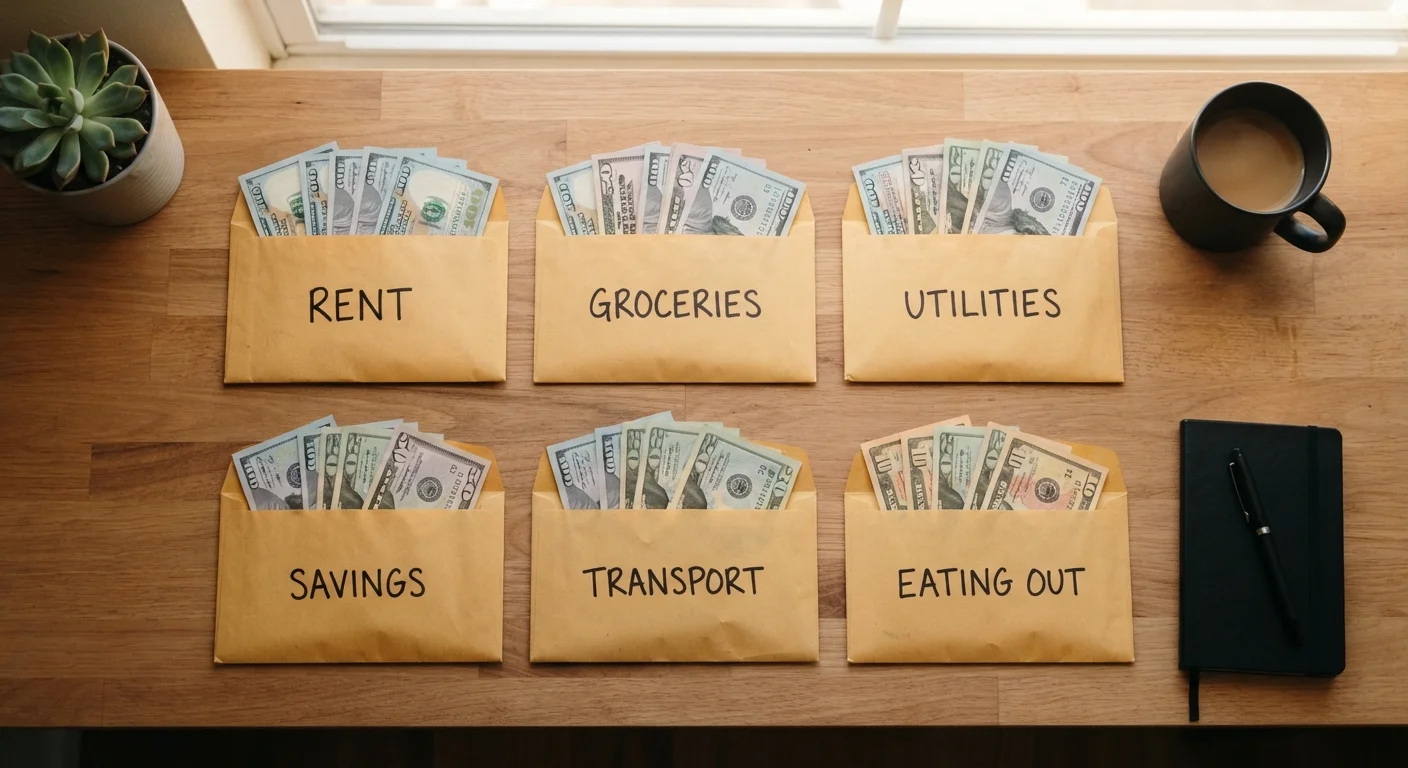
Envelope budgeting begins with a single question: how much take-home income will you receive this month? Before you pay a bill or buy a coffee, that total gets divided across labeled categories. Each label - groceries, transport, utilities, dining out - becomes an envelope funded with a set cash amount.
The rule is strict by design: each category can only draw from its own envelope. Once you've reached the limit, that category is closed until you refill at the start of the next pay period. If you want to overspend in one area, you must consciously pull money from another, making the trade-off explicit rather than invisible.
Before setting allocations, it helps to understand where your money currently flows. The article Where Your Money Actually Goes Each Month walks through mapping your real spending patterns - a useful step before assigning envelope amounts.
Start With Fewer Categories
New envelope budgeters often create too many categories, which becomes difficult to maintain. Begin with five to eight broad buckets - housing, food, transport, personal, and savings - and subdivide only when you have a reason to. Simplicity sustains the habit.
The Psychology Behind the Method
Paying with a card feels abstract. Handing over physical cash - or watching a digital counter drop to zero - triggers a different emotional response. Behavioral researchers describe this as the "pain of paying," and it is more acute when money is tangible and finite.
Envelope budgeting exploits this cognitive pattern deliberately. Because each envelope holds a visible, fixed pool, the decision to spend becomes conscious. There is no silent overdraft or end-of-month surprise. This visibility is why many people who struggle with abstract spreadsheets find the envelope approach unexpectedly effective.
“The act of paying cash makes the cost of a purchase more salient and memorable. When payment is more painful, people tend to spend less and remember the transaction more vividly.”
— Drazen Prelec, Professor of Management Science and Economics, MIT Sloan School of Management
The method also reduces decision fatigue. Because allocation decisions happen once at the start of the month, day-to-day spending requires less mental effort - you simply check your envelope before buying.
Modern Adaptations
Physical cash envelopes are impractical for digital transactions like online bills or card-only merchants. Several budgeting apps replicate the envelope structure digitally: income is deposited into virtual category buckets, and each purchase draws down the relevant bucket in real time.
The mechanics remain identical to the paper version - only the medium changes. Some households use a hybrid approach: physical envelopes for high-temptation variable categories like dining and entertainment, and digital tracking for fixed expenses like rent and subscriptions.
~33%
Adults without a structured monthly budget
Survey data from multiple European financial literacy studies consistently finds roughly one-third of adults manage money without any formal budgeting structure.
20-30%
Typical overspend in discretionary categories
Behavioral finance research indicates consumers commonly underestimate discretionary spending by 20-30% when relying on mental tracking rather than explicit category limits.
For anyone exploring how envelope budgeting compares with other structured frameworks, Zero-Based Budgeting vs. Percentage-Based Budgeting offers a direct comparison. A broader look at all common approaches is available in Budgeting Approaches Worth Knowing.
Setting Up Your Envelopes
A workable setup follows three steps. First, calculate your monthly net income - the actual amount deposited after tax and deductions. If you're unfamiliar with core terms like net income or discretionary spending, Key Budgeting Terms Every Beginner Should Know is a plain-language reference.
- List fixed expenses first. Rent, insurance, and loan repayments have non-negotiable amounts. Fund these envelopes before anything else.
- Estimate variable categories. Use recent bank statements to set realistic caps for groceries, fuel, and personal spending. Underfunding leads to frustration; leave a small buffer initially.
- Include a savings envelope. Treat savings as a non-optional category, not a leftover. Connecting this habit to longer-term goals is supported by the resources in Saving Money.
After two to three months, your allocation figures will become more accurate as you learn your real spending patterns. Adjust category amounts at each monthly reset rather than mid-month, to preserve the discipline the system is designed to create.
For a complete picture of how envelope budgeting fits into the broader discipline of personal finance, Personal Budgeting: A Complete Guide covers every stage from income mapping to monthly review.
This article is for general informational purposes only and does not constitute personalised financial advice. Consider consulting a qualified financial adviser for guidance tailored to your individual circumstances.