
What Makes a Community a Community?
Sociologists broadly define a community as a group of people who share something meaningful - a place, a purpose, an identity, or a set of norms - and who maintain some form of ongoing relationship as a result. But that definition leaves enormous room for variation. The structures through which humans organise belonging are astonishingly diverse, shaped by history, ecology, religion, economics, and migration.
Understanding those structures matters. Research consistently links strong community ties to improved wellbeing, resilience during hardship, and a greater sense of meaning. To explore why, see the science behind why humans need to belong. The list below surveys some of the most significant forms communities take - not as a ranking, but as a window into human social creativity.
Kinship Networks
The most ancient community structure is kinship - families, clans, and lineage groups bound by blood, marriage, or adoption. In many societies, kinship networks remain the primary unit of economic cooperation, childcare, eldercare, and conflict resolution. Anthropologist Robin Dunbar's research suggests humans can maintain roughly 150 stable social relationships, and in many traditional societies, kinship groups occupy the core of that number. Kinship-based communities vary widely: the nuclear family of industrialised societies is far from universal; extended household compounds, matrilineal clans, and fictive kinship (treating non-relatives as family) are common worldwide.
Kinship networks are the oldest form of human community, found in every known society.
Faith Congregations
Religious communities organise belonging around shared belief, practice, and ritual. Mosques, churches, synagogues, temples, and informal prayer circles do more than provide spiritual meaning - they typically function as social safety nets, offering support during illness, bereavement, and financial difficulty. Sociologist Robert Putnam's research in the United States found that religious participation was one of the strongest predictors of civic engagement and social trust. Faith communities are also notable for their cross-class mixing: people of different economic backgrounds often share the same pew, something rare in other social contexts.
Faith communities often function as social safety nets as much as spiritual ones.
Diaspora and Transnational Communities
Migration has produced a distinct community form: the diaspora group, whose members share an origin culture while living dispersed across multiple countries. Chinese, Indian, Irish, Jewish, and many other diaspora communities have developed robust transnational networks - maintaining language schools, cultural associations, remittance systems, and collective memory across generations and borders. These communities challenge the assumption that geography is essential to belonging. Identity, shared narrative, and communication technology can sustain cohesion across vast distances, though tensions between heritage maintenance and assimilation are common and well-documented.
Diaspora communities show that shared identity can sustain belonging across continents and generations.
Professional Guilds and Occupational Communities
From medieval trade guilds to modern professional associations, people have long organised around shared craft or occupation. These communities regulate standards, transmit knowledge, provide solidarity during economic hardship, and confer status. Contemporary examples include bar associations, medical colleges, trade unions, and informal professional networks. Occupational communities often develop their own cultures - distinct language, humour, ethics, and identity. Research on nursing, policing, academia, and skilled trades all document how deeply work-based community shapes individual identity and moral commitments.
Occupational communities don't just share skills - they forge shared identities and ethical codes.
Mutual Aid and Cooperative Networks
Mutual aid societies - groups that pool resources to support members during hardship - have existed across cultures for centuries. Examples include the tontine savings circles common across West Africa and diaspora communities, Japanese moai social support groups, and the formal mutual aid societies that supported immigrant communities in nineteenth-century Europe and the Americas. Modern cooperatives - worker-owned businesses, housing cooperatives, credit unions - carry forward this tradition. These structures are notable for organising community around economic interdependence rather than ethnicity, faith, or geography alone.
Mutual aid structures show that economic interdependence can be a foundation for lasting community.
Place-Based and Neighbourhood Communities
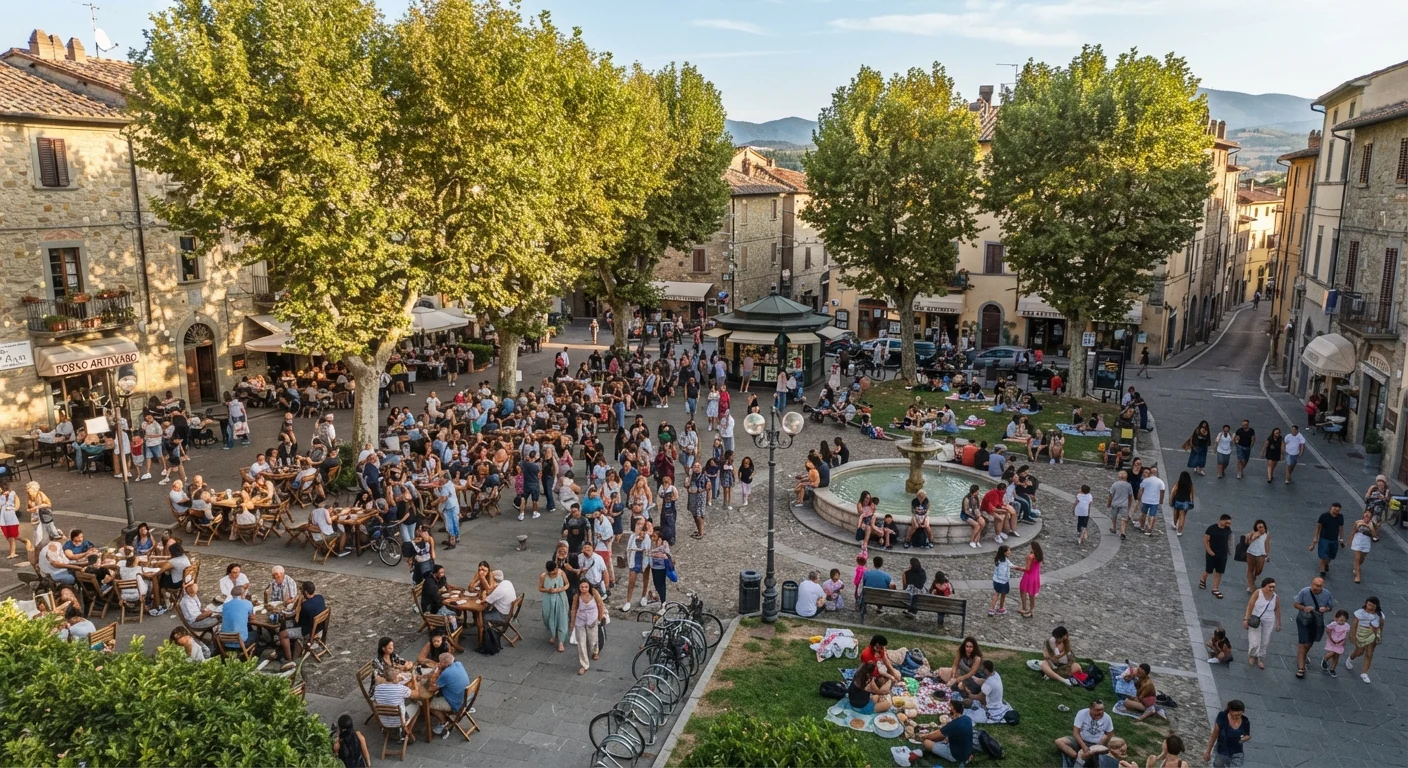
Geographic proximity has historically been one of the most reliable community-forming forces. Neighbourhoods, villages, and urban quarters develop shared norms, local institutions, and collective identity simply through sustained co-presence. Urban sociologists have documented how shared public spaces - parks, markets, community centres - anchor neighbourhood cohesion. However, car-dependent urban design, housing unaffordability, and rapid gentrification have eroded place-based community in many cities, making this once-default form of belonging increasingly precarious for many residents.
Shared public space is often the invisible infrastructure that holds neighbourhood communities together.
Interest-Based and Affinity Communities
Communities organised around shared interests - amateur sports clubs, book groups, maker spaces, fan communities - represent a distinctly modern proliferation. As traditional community structures (parish, guild, village) have weakened in urbanised societies, voluntary affinity groups have partly filled the gap. These communities are opt-in and less binding than kinship or place, but they can generate genuine solidarity and sustained friendship. Sociologists note that they tend to be more homogeneous by class and education than older community forms, which has implications for the breadth of social bridges they build.
Interest-based communities have partly filled the gap left by declining traditional social structures.
A Shared Thread Across All Forms
What unites these very different structures is the presence of reciprocity - a sense that membership involves both giving and receiving. Whether that plays out through shared meals, professional mentorship, collective prayer, or emergency mutual aid varies enormously. But the underlying dynamic is consistent with what anthropologists call social capital: the trust and norms that emerge from sustained interaction.
Belonging Can Be Cultivated
Researchers note that people often underestimate how much community membership depends on repeated, low-stakes interaction rather than grand gestures. Regular attendance at a neighbourhood association, a weekly sports game, or a recurring community meal tends to build social trust gradually. Showing up consistently matters more than intensity of involvement.
Communities are also not static. They shift as circumstances change, and sometimes they fracture. Social fragmentation isn't random - sociologists have traced the specific pressures that erode communities over time, and the practices that sustain them. Similarly, the rise of digital networks has introduced genuinely new community dynamics; online and in-person communities work in distinct ways that are still being mapped by researchers. For broader context on how social forces shape everyday life, explore current social trends.