

Principal, Interest, and Why Both Matter
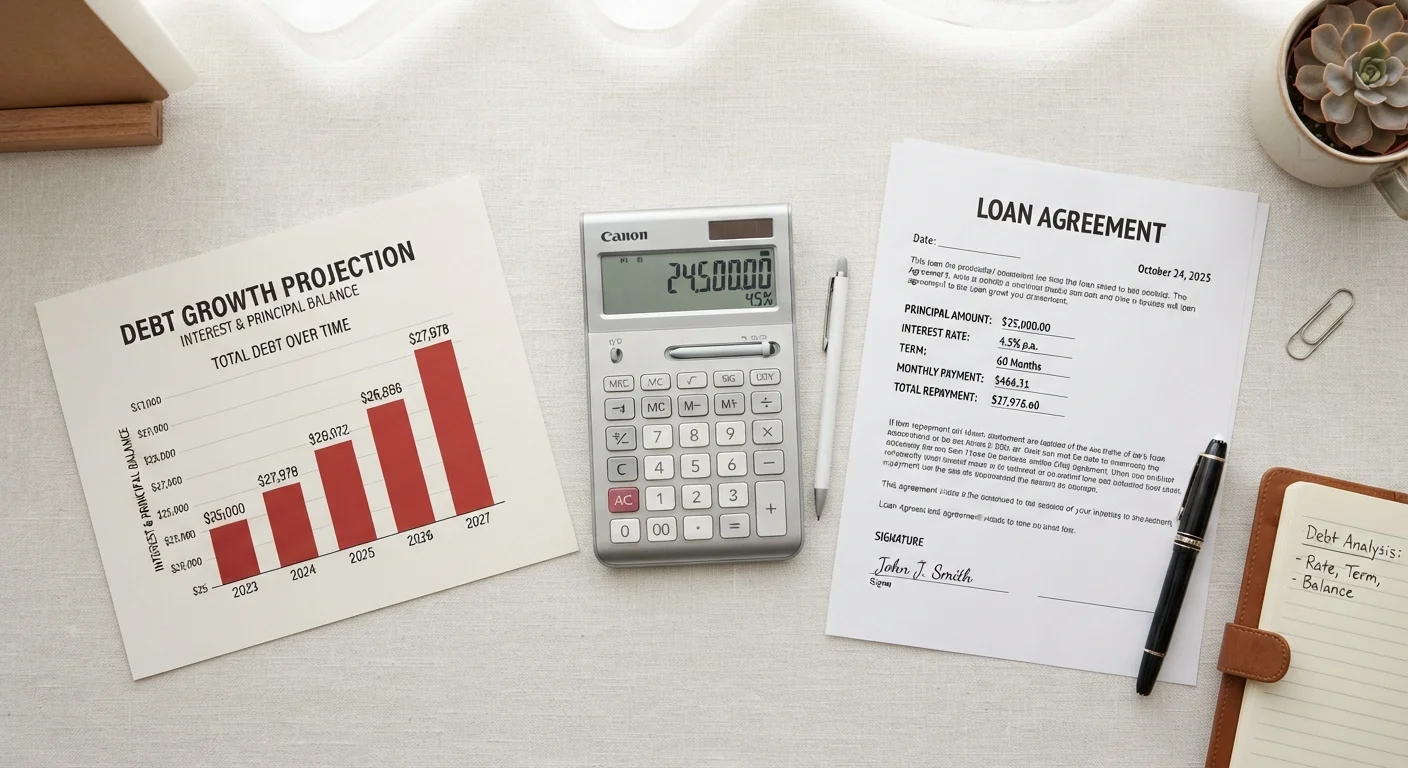
Every debt has two core components: the principal - the amount you originally borrowed - and interest - the lender's charge for making that money available to you. When you make a payment, it is split between reducing the principal and covering accrued interest. Early in most loan terms, a larger share of each payment goes toward interest. As the principal shrinks, more of each payment chips away at what you actually owe.
For a deeper grounding in how debt functions from the start, see our plain-language guide to how debt works. Understanding this split is essential because it explains why paying the bare minimum can keep you in debt far longer than expected.
20%+
Average U.S. credit card APR
According to the U.S. Federal Reserve, average credit card interest rates have consistently exceeded 20% APR in recent years, making revolving balances particularly costly.
~$1,380
Extra interest on a $5,000 balance over 2 years at 20% APR
A rough illustration of compound interest on a $5,000 credit card balance carried for two years at 20% APR, assuming no new charges and minimum payments only.
Simple vs. Compound Interest: A Critical Distinction
Simple interest is calculated only on the original principal. If you borrow $1,000 at 10% simple interest for one year, you owe $100 in interest - straightforward and predictable. Some personal loans and auto loans use this method.
Compound interest is calculated on the principal plus any interest that has already accrued. This is how most credit cards and many other revolving credit products work. Suppose you carry a $1,000 balance at a 20% APR and make no payments. After the first month, roughly $16.67 in interest is added. The next month, interest is calculated on $1,016.67 - not the original $1,000. Over time, this compounding effect accelerates how quickly a balance grows.
Credit Card Grace Periods and Interest Avoidance
Most credit cards offer a grace period - typically 21 to 25 days after the billing cycle closes - during which no interest is charged on new purchases if you pay the full statement balance by the due date. Carrying even a small unpaid balance from the previous month can eliminate this grace period, causing interest to accrue from the day of each purchase.
The compounding frequency matters too. Interest may compound daily, monthly, or annually. Daily compounding - common with credit cards - results in slightly more total interest than monthly compounding at the same stated rate.
APR Explained: The Number That Tells the Full Story
The Annual Percentage Rate (APR) is the standardised figure lenders are required to disclose. It combines the base interest rate with certain fees to express the yearly cost of borrowing as a single percentage. Because it accounts for more than just the raw interest rate, APR is the most reliable figure to use when comparing two loan offers side by side.
However, APR has limits. It does not reflect the impact of compounding within a year - that is captured by the Annual Percentage Yield (APY), which is more commonly referenced in savings contexts. For most borrowers comparing personal loans, credit cards, or mortgages, APR is the right starting point.
Compare APRs Before Committing to Any Loan
When evaluating borrowing options, request the APR - not just the stated interest rate - from each lender. A lower headline rate with high fees can cost more than a slightly higher rate with no fees. Running a side-by-side APR comparison is one of the simplest ways to avoid paying more than necessary over a loan's life.
For a handy reference to these and related terms, consult our debt terminology glossary.
Fixed vs. Variable Rates and What They Mean for Repayment
A fixed interest rate does not change over the life of the loan. Your monthly payment stays predictable, which simplifies budgeting. Mortgages and many personal loans often offer fixed rates.
A variable interest rate is tied to a benchmark rate - such as the prime rate - and adjusts periodically. When the benchmark rises, so does your rate and often your minimum payment. Variable rates can start lower than fixed rates but introduce uncertainty into long-term planning.
Understanding your rate type matters especially when debt levels are significant. Your debt-to-income ratio - the proportion of your monthly income committed to debt payments - can shift meaningfully if a variable rate rises.
Once you understand how interest accumulates, the logical next step is choosing a repayment strategy. Our overview of debt repayment approaches walks through the most common methods and the trade-offs each involves.
This article is for general informational and educational purposes only and does not constitute personalised financial advice. For guidance specific to your situation, consult a qualified financial professional.