
What Is an Ecosystem?
An ecosystem is a community of living organisms - plants, animals, fungi, and microbes - interacting with each other and with their nonliving surroundings. Those surroundings include sunlight, water, soil chemistry, temperature, and terrain. Together, the living (biotic) and nonliving (abiotic) components form a functional system governed by flows of energy and matter.
Ecosystems come in every size imaginable. A single rotting log teeming with beetles, mosses, and fungi is a micro-ecosystem. The Amazon basin, spanning millions of square kilometers, is a macro-ecosystem of extraordinary complexity. What matters is not scale but interconnection: every component influences others.
Ecosystem
A community of living organisms plus the nonliving environment they inhabit, interacting as a unified system through flows of energy and matter.
Biotic and Abiotic
Biotic refers to all living components of an ecosystem (plants, animals, microbes). Abiotic refers to nonliving factors like temperature, water, soil, and sunlight.
Trophic Level
A position in a food chain defined by how an organism obtains energy - producers are at the first level, then primary consumers, then secondary consumers, and so on.
Keystone Species
A species whose ecological role is disproportionately large relative to its abundance; its removal triggers significant changes across the ecosystem.
Biogeochemical Cycle
The pathway through which a chemical element or molecule moves between living organisms, the atmosphere, water, and soil in a continuous loop.
Ecological Succession
The gradual process by which an ecosystem changes and develops over time after a disturbance, moving toward a more stable community structure.
Ecosystem Services
The benefits that functioning ecosystems provide to all life, including humans - such as clean water, pollination, soil formation, and climate regulation.
Trophic Cascade
A chain reaction through a food web triggered by the addition or removal of a top predator, causing changes in population sizes at multiple lower trophic levels.
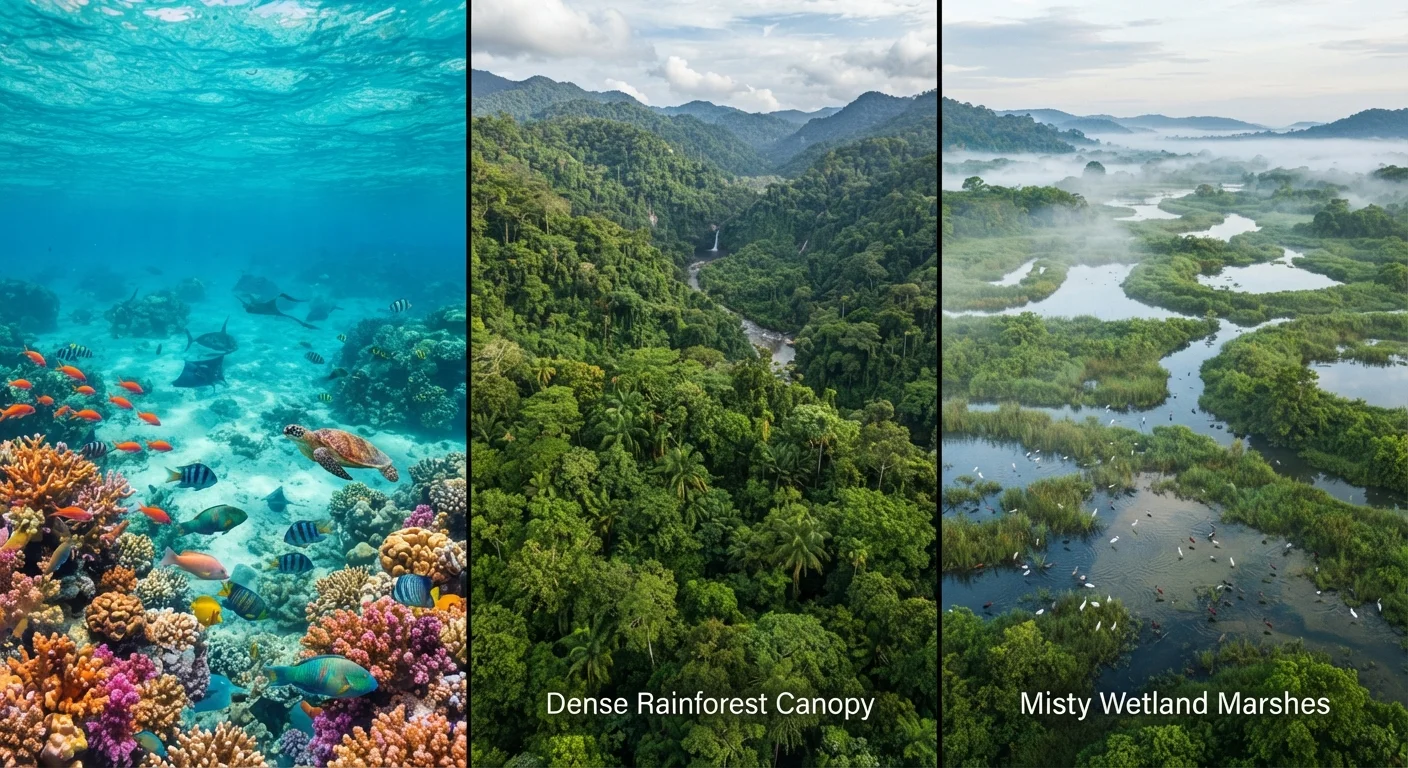
For a richer look at how Earth's most complex ecosystems compare in structure and vulnerability, see Coral Reefs, Rainforests, and Wetlands compared.
Producers, Consumers, and Decomposers
Every ecosystem organizes its organisms into functional roles based on how they acquire energy.
- Producers (autotrophs) - mostly plants and algae - capture solar energy through photosynthesis, converting carbon dioxide and water into sugars. They form the foundation of nearly all food chains.
- Consumers (heterotrophs) obtain energy by eating other organisms. Primary consumers (herbivores like deer or caterpillars) eat producers. Secondary consumers prey on primary consumers, and so on up the chain.
- Decomposers - bacteria, fungi, and certain invertebrates - break down dead organic matter, releasing nutrients back into soil and water. Without them, nutrients would remain locked in dead tissue and ecosystems would collapse.
Spot Decomposers on Your Next Walk
Decomposers are the easiest ecological role to observe in everyday settings. Lift a damp log in a forest or park and look for fungi, pill bugs (isopods), and millipedes - all actively breaking down organic matter. This simple observation grounds abstract nutrient-cycle concepts in something immediate and real.
These three functional groups mirror a logic familiar to anyone who has thought about energy sources in daily life, much as understanding macronutrients frames how the body uses food - a parallel explored in Nutrition from Scratch.
Food Webs and Energy Flow
A food chain is a linear sequence showing who eats whom - grass → grasshopper → frog → heron, for example. In reality, most species eat multiple things and are eaten by multiple others, creating an interlocking food web.
Energy flows through a food web in one direction only. At each trophic level (feeding position), roughly 90% of available energy is lost as metabolic heat. This means a producer must fix a large amount of solar energy to support even a small population of top predators. It explains why ecosystems can sustain far more plant biomass than animal biomass, and more herbivores than carnivores.
Oversimplifying Food Chains Can Mislead
Food chains presented as neat linear sequences are useful teaching models but can obscure real ecological complexity. Most organisms participate in multiple chains simultaneously, and the actual network of feeding relationships is far more dynamic. Use food chains as entry points, not complete descriptions.
Some species hold disproportionate influence over their food web - ecologists call these keystone species. Sea otters, wolves, and fig trees are well-documented examples. When a keystone species is removed, the food web can restructure dramatically, sometimes eliminating dozens of dependent species in what ecologists call a trophic cascade.
Nutrient Cycles That Keep Life Running
Unlike energy, which flows in and is eventually lost as heat, nutrients cycle continuously through ecosystems. The major biogeochemical cycles - carbon, nitrogen, and phosphorus chief among them - link living organisms to the atmosphere, soil, and water.
- Carbon cycle: Photosynthesis pulls carbon dioxide from the atmosphere into plant tissue. Respiration, decomposition, and combustion return it. Oceans absorb roughly a quarter of human-produced CO₂, moderating atmospheric concentrations.
- Nitrogen cycle: Nitrogen gas makes up 78% of the atmosphere but is unusable by most organisms in that form. Specialized bacteria convert it to ammonium and nitrate - forms plants can absorb. Decomposers and other bacteria eventually return it to the atmosphere.
- Phosphorus cycle: Phosphorus lacks a gaseous phase; it weathers from rocks, moves through soil and water, is absorbed by plants, travels up food chains, and returns via decomposition.
Disrupting these cycles - through excess fertilizer runoff or deforestation, for example - can produce measurable ecological consequences, including algal blooms and soil degradation.
Why Biodiversity Matters
Biodiversity - the variety of life at genetic, species, and ecosystem levels - is not merely a measure of ecological richness; it is a functional property that underpins stability. Ecosystems with higher species diversity tend to be more resilient: when one species declines, others with overlapping roles can compensate, preventing catastrophic energy or nutrient bottlenecks.
Ecologists use the term ecosystem services to describe the benefits ecosystems provide to all life, including humans: clean water filtration, soil formation, pollination, carbon sequestration, and climate regulation. These services depend on biodiversity functioning as expected.
Biodiversity Loss Is an Active Research Area
Scientific understanding of biodiversity and extinction rates continues to develop. Estimates of current species loss vary depending on methods used and taxa studied. Readers interested in the latest findings should consult peer-reviewed sources such as journals like Nature or Science, or reports from the Intergovernmental Science-Policy Platform on Biodiversity and Ecosystem Services (IPBES).
Species loss is accelerating globally, driven by habitat destruction, invasive species, pollution, and climate change. Ecologists widely regard current extinction rates as significantly elevated above natural background levels, though precise figures involve substantial scientific debate and ongoing research.