

Fueling a Journey of Thousands of Miles
Migration is one of the most energetically demanding activities in the animal kingdom. To understand what it truly costs a bird, start with fuel. Before setting off, birds enter a state called hyperphagia - a period of intense, compulsive feeding that can last days or weeks. During this phase, fat deposits accumulate rapidly beneath the skin and around organs, sometimes doubling a bird's normal body weight.
Fat is not just convenient; it is remarkably efficient. Gram for gram, fat stores more than twice the energy of carbohydrates or protein, making it the ideal aviation fuel for a creature where every extra gram adds drag. A Ruby-throated Hummingbird weighing roughly 3 grams at departure may cross the entire Gulf of Mexico - approximately 950 kilometers - on a single fuel load, arriving measurably lighter on the other side.
~11,000 km
Non-stop flight distance of Bar-tailed Godwit
Satellite tracking studies have recorded Bar-tailed Godwits flying non-stop from Alaska to New Zealand - the longest known non-stop bird migration.
Up to 50%
Body mass lost on a single long crossing
Research on trans-Gulf and trans-Saharan migrants has documented individual birds losing up to half their departure body weight on a single non-stop leg.
0.3-0.5%
Body mass burned per hour of flight
Studies using doubly labeled water and flight range equations estimate small passerines burn roughly 0.3-0.5% of their body mass per hour during sustained migratory flight.
But fat alone does not explain the full picture. Toward the end of extreme non-stop flights, birds begin catabolizing muscle protein to sustain output. The pectoral muscles - the powerhouse of flapping flight - may actually shrink slightly during the journey, while the heart and remaining flight muscles are preserved as long as possible.
The Radical Biology of Preparation
Perhaps the most striking adaptation birds make before long migrations is organ remodeling. Studies of shorebirds such as the Bar-tailed Godwit have documented the near-complete shrinkage of the stomach, intestines, liver, and kidneys prior to departure. These organs are metabolically expensive to maintain, and jettisoning their mass frees up capacity for additional fat and muscle.
Upon arrival at a stopover site, digestion must resume rapidly - and the digestive system regrows to near-normal size within days. This capacity for reversible organ atrophy and regeneration, called phenotypic flexibility, is a hallmark of long-distance migratory birds and has no close parallel in most other vertebrate groups.
How Birdwatchers Can Help Migrants
Providing native plantings and water sources in yards and gardens offers meaningful refueling resources for migrants passing through. Keeping domestic cats indoors during peak spring and autumn migration periods - typically April-May and August-October in North America - can also reduce predation on birds that arrive exhausted and temporarily ground-bound.
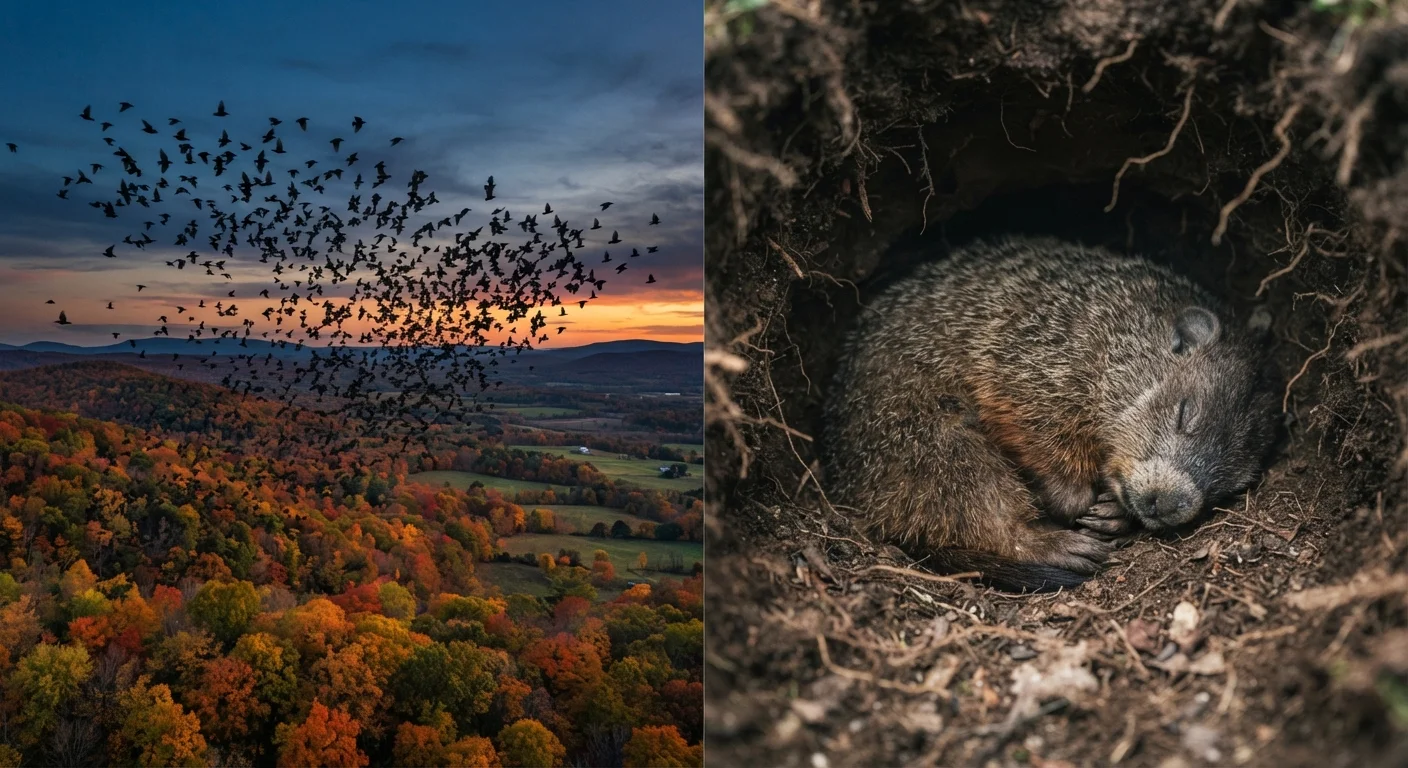
Compared to the strategy of remaining dormant through winter, active migration carries a completely different set of physiological trade-offs. Migration versus hibernation represents two fundamentally distinct biological solutions to the same seasonal challenge, each with distinct costs and benefits shaped by millions of years of evolution.
Risks That Cannot Be Stored Away
Energy expenditure is only one dimension of migratory cost. Birds in transit face compounding risks that cannot be offset by preparation alone. Predation is significantly elevated at stopover sites, where birds congregating near food sources also attract predators - raptors, domestic cats, and snakes among them. A bird arriving depleted after a long crossing has reduced maneuverability and slower reaction times, making it especially vulnerable.
Weather poses its own threats. Storms can force birds off course, strand them over open water, or deposit them far outside their normal range. Cold snaps mid-migration can eliminate insect food sources that arriving birds depend on for rapid refueling.
Habitat degradation has emerged as one of the most consequential modern threats. When stopover sites are developed, drained, or invaded by non-native plant species that support fewer insects, an entire leg of a migratory route can effectively collapse. Research tracking marked individuals has shown that poor refueling conditions at a single stopover can cascade into delayed arrivals on breeding grounds, reduced reproductive success, and elevated mortality - a chain of consequences that follows from a single disrupted rest stop.
Understanding what migration truly costs a bird reframes how we think about the landscapes birds pass through. The breeding ground and the wintering ground are obvious focal points for conservation, but the invisible thread of stopover sites connecting them is equally critical - and often more fragile.