

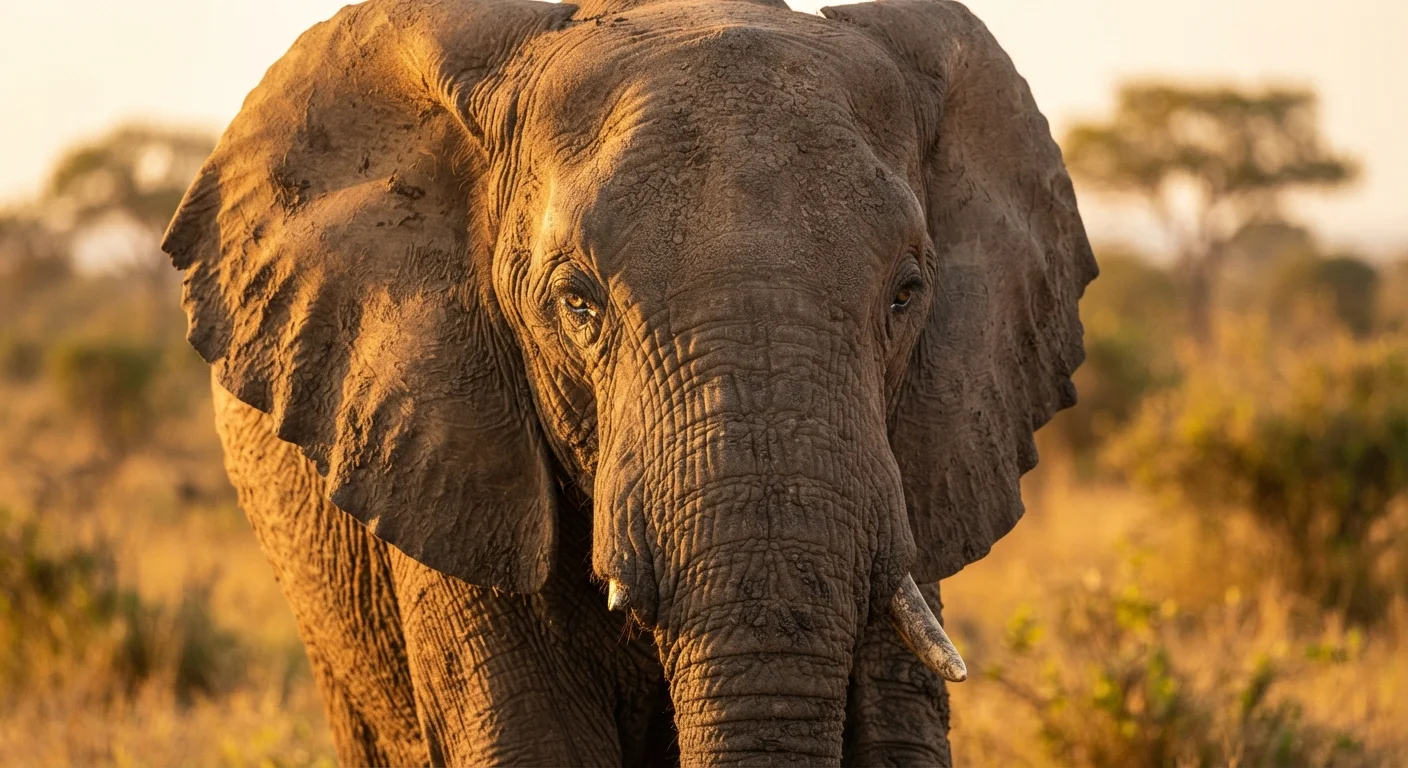
The Brain Behind the Memory
An adult African elephant brain weighs approximately 5 kilograms - the largest of any land mammal by absolute mass. More significant than raw size is its architecture. Elephants have a well-developed hippocampus, the brain region most associated with long-term memory and spatial mapping. Their temporal lobes, linked to social recognition and emotional processing, are also proportionally enlarged.
Neuroanatomical studies have documented a high density of neurons in the elephant cortex, rivaling those found in cetaceans and great apes. This structural complexity underpins the behavioral sophistication observed in the field. Understanding these mechanisms connects directly to the broader discipline of ethology - the scientific study of animal behavior, which provides the frameworks researchers use to interpret what elephants actually do with such a brain.
~5 kg
Average elephant brain weight
The African elephant brain is the largest of any terrestrial mammal, according to comparative neuroanatomy studies.
60+ years
Lifespan over which social memory operates
Field research has tracked individual elephants recognizing herd members and locations across their full multi-decade lives.
3
Non-human species passing mirror self-recognition
Elephants join great apes and certain dolphins and corvids in demonstrating mirror self-recognition, per peer-reviewed cognitive research.
Matriarchal Memory and Herd Survival
In elephant society, the oldest female - the matriarch - functions as a living archive. Field research conducted across African savannas has shown that herds led by older matriarchs make better survival decisions during droughts, show more appropriate responses to predator threats, and maintain larger, more stable social networks.
One well-documented set of studies found that matriarchs could discriminate between the calls of familiar and unfamiliar elephants, even after years of separation. They also showed heightened vigilance in response to the scent of musth-state males - a state of heightened hormonal activity - suggesting fine-grained, long-retained social knowledge rather than simple pattern recognition.
“The elephant matriarch is essentially functioning as the group's external hard drive. She stores and retrieves information that the rest of the group relies on for survival decisions they could not make on their own.”
— Karen McComb, Professor of Animal Behaviour, University of Sussex, and lead researcher on elephant social cognition
This accumulated knowledge is not instinct - it is learned, retained, and applied across decades. When a matriarch dies, the loss reverberates through herd decision-making in measurable ways.
Empathy, Grief, and Social Intelligence
Elephants display behaviors that researchers interpret as empathy and mourning. When a herd member dies, others frequently return to the remains over days or weeks, touching bones with their trunks and standing in apparent stillness. These responses have been documented across both African and Asian elephant populations and are not limited to close genetic relatives.
Elephants also comfort distressed individuals through touch and vocalizations, and they cooperate on tasks requiring coordinated effort - behaviors that indicate theory of mind, or the ability to understand another individual's mental state. This places them among a very small number of species demonstrating such social complexity.
Context Matters in Cognitive Research
When interpreting elephant behavior, researchers are careful to distinguish between learned responses, instinct, and genuine cognitive flexibility. Ethological methods - observing animals in naturalistic settings over long periods - are essential to drawing reliable conclusions about what animals actually understand versus what they have been conditioned to perform.
Self-recognition, tested using mirror paradigms, has been confirmed in Asian elephants. Subjects investigated their own reflections and showed mark-directed behavior - touching spots on their own bodies visible only in the mirror - a benchmark used across cognitive science to infer self-awareness.
Memory, Migration, and Ecological Knowledge
Elephant memory is not purely social. Herds navigate landscapes spanning thousands of square kilometers, returning reliably to water sources, salt licks, and foraging grounds visited years or even decades earlier. GPS tracking studies have revealed that migration routes align closely with historical pathways, even when the landscape has changed around them.
During severe droughts, older individuals have led herds to water sources outside typical ranges - locations the younger animals had never visited. This suggests episodic-like memory: the ability to recall specific past experiences and apply them to novel present circumstances.
The cognitive capacities elephants deploy to navigate, remember social bonds, and read environmental signals represent one of evolution's most compelling experiments in intelligence - one that continues to reshape our understanding of what animal minds are capable of.