
The Invisible Architecture of Belonging
Every community has a boundary - not always a visible one, but a boundary nonetheless. It is the line between those who feel at home and those who sense, sometimes immediately, that they are a guest rather than a member. Understanding how that boundary is drawn, maintained, or dismantled is one of the central questions of sociology.
To understand what inclusion and exclusion actually mean, it helps to start with what makes a community in the first place. As our exploration of community ingredients explains, shared identity, place, and purpose are the foundational elements. When someone enters a community who does not immediately share those elements, the group faces a choice - conscious or not - about how to respond.
That response is rarely random. It follows patterns shaped by history, economics, and the internal culture of the group.
About This Article
This article presents general sociological concepts and research findings for educational purposes. The dynamics of inclusion and exclusion vary considerably across cultures, regions, and specific communities. No single framework captures every situation, and the patterns described here are tendencies, not universal laws.
What Makes a Community Open or Closed
Sociological research consistently identifies several factors that predict how welcoming a community will be to difference. Economic security is one of the most robust: groups facing scarcity - of jobs, housing, or status - tend to perceive outsiders as competitors rather than additions. This is not a fixed characteristic of any group; the same community can become more open as conditions change.
A second factor is the strength and flexibility of the group's shared identity. Communities with a confident but adaptable sense of who they are tend to absorb newcomers more successfully than those whose identity is fragile or rigidly defined. A group that defines itself narrowly - by a single ethnicity, religion, or viewpoint - has fewer points of entry for people who do not fit that mould precisely.
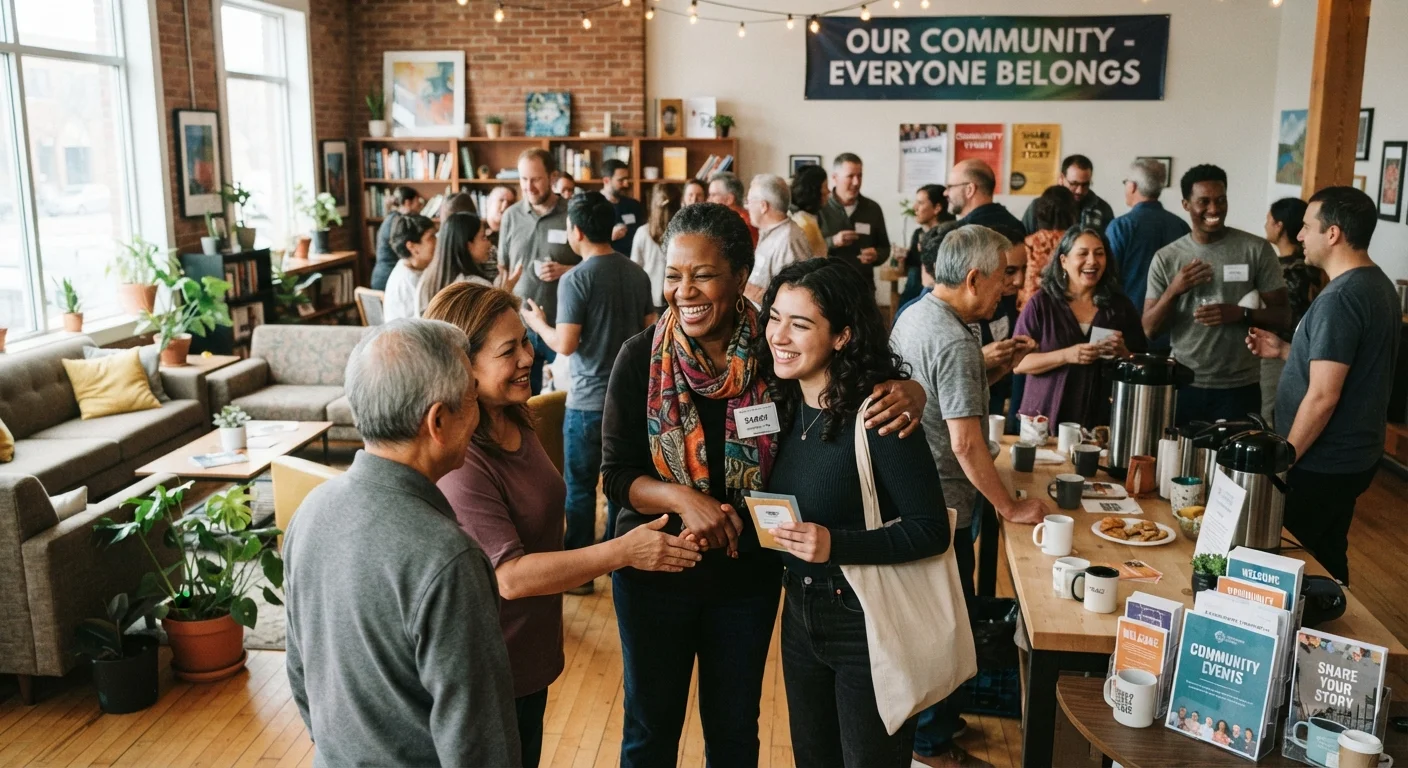
Third places - the libraries, parks, cafés, and community halls where people mix informally - also play a structural role. As discussed in our look at what sociologists mean by third places, these spaces create the conditions for low-stakes contact that can eventually build genuine connection. Their absence, increasingly common in many urban and suburban areas, removes an important mechanism for integration.
~60%
People reporting a sense of community belonging
Gallup's global wellbeing research has consistently found that around six in ten adults report a sense of belonging to their local community, with significant variation by country and urban-rural context.
2-7 years
Time for migrants to report full social integration
Studies on immigrant integration in several European countries suggest that social belonging - as distinct from legal or economic integration - often takes between two and seven years to develop, and is influenced heavily by language access and local reception.
40%
Reduction in prejudice through structured contact
A landmark 2006 meta-analysis of over 500 studies on intergroup contact theory found that positive, structured contact between groups is associated with meaningful reductions in prejudice across a wide range of settings.
The Many Faces of Exclusion
Exclusion is not always dramatic. It rarely announces itself with hostility. More often, it operates through what researchers describe as soft exclusion: the slow non-invitation, the conversation that quietly closes when someone new approaches, the assumed shared reference that signals who the real insiders are. These mechanisms are powerful precisely because they are deniable - no one did anything wrong, yet someone was left outside.
Newcomers navigating the unwritten rules of any community face a particular version of this challenge. Long-timers often hold informal power through their knowledge of norms, history, and relationships. Those norms are rarely written down, which makes violation easy and correction slow.
Structural forms of exclusion - segregated housing, differential access to institutions, economic stratification - compound the interpersonal. A person may be individually welcomed in a neighbourhood while still being systematically excluded from its schools, credit systems, or civic processes. Both dimensions need to be addressed for inclusion to be meaningful.
How Absorption Actually Happens
Genuine community absorption - as opposed to mere tolerance - tends to require several overlapping conditions. Contact between groups matters, but the quality of that contact is what determines its effect. Decades of research following the work of social psychologist Gordon Allport suggest that contact produces positive outcomes most reliably when it involves equal status, shared goals, cooperation, and institutional support. Superficial proximity rarely produces connection on its own.
Participation is another mechanism. When someone from outside the dominant group contributes visibly - organising an event, coaching a team, leading a local initiative - their identity expands within the community's story. They are no longer just a newcomer; they are someone who did something. This is why communities that actively create roles for newcomers tend to integrate them more successfully than those that simply wait for assimilation to happen.
It is also worth noting that communities and individuals differ in the kind of difference they find easiest to accommodate. The distinction between geographic and interest-based communities matters here: communities of interest often have self-selecting membership that makes difference on the defining dimension rarer, while geographic communities must negotiate diversity they did not choose.
“The test of our progress is not whether we add more to the abundance of those who have much; it is whether we provide enough for those who have too little - and whether we make room for those who stand apart.”
— Gordon Allport, Social psychologist and author of 'The Nature of Prejudice' (1954)