

More Than a Label: What Shared Identity Actually Means
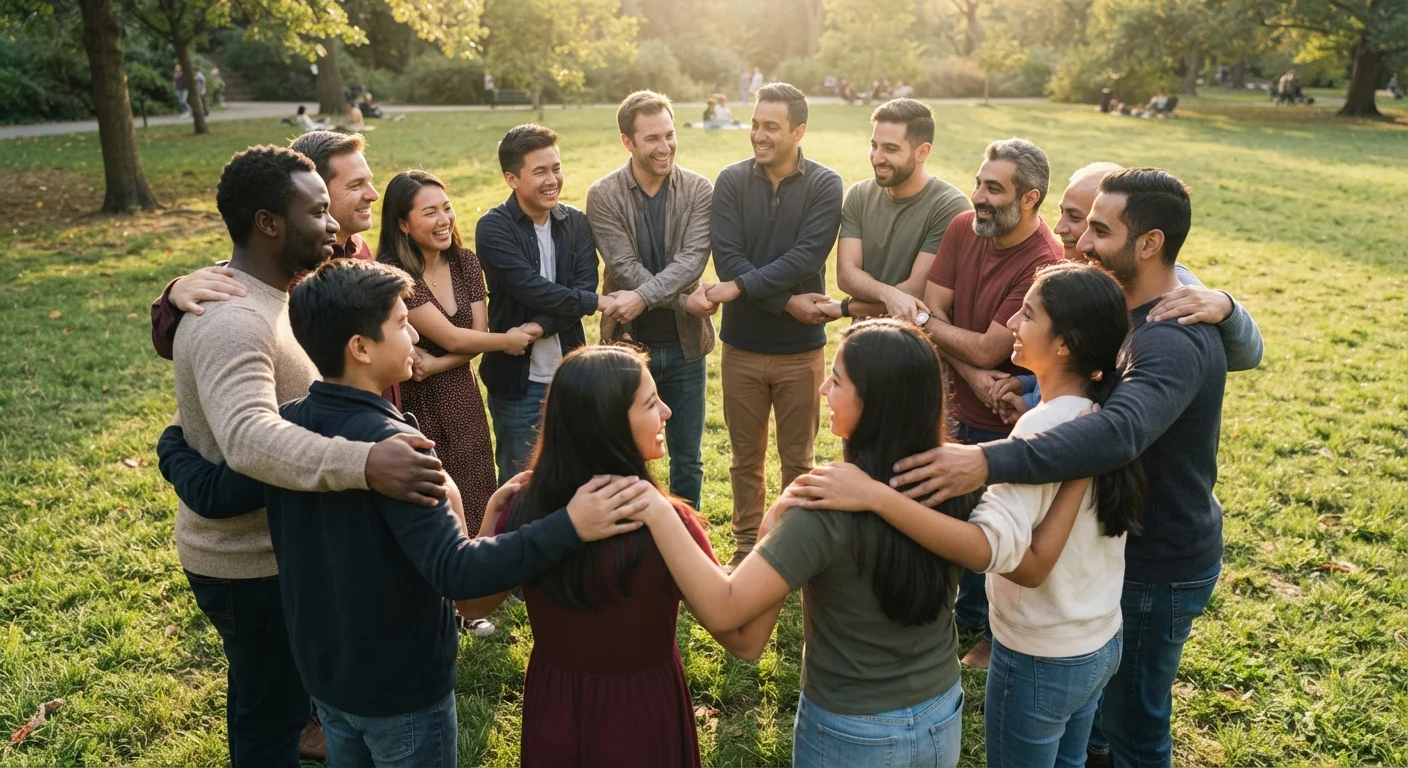
Walk into any sports stadium on match day and you will feel it - thousands of strangers behaving as though they know each other, moving through grief or elation together as one. That experience is shared identity in action. It is not merely wearing the same colors; it is internalizing a collective 'we' that reshapes how you see yourself and others.
Sociologists draw a careful distinction between a social category - people who happen to share a characteristic - and a social group whose members identify with one another. A category might be 'people born in the same decade.' A group is what forms when those people start saying 'we grew up through the same things' and invest meaning in that connection. The shift from category to identity is where community begins.
What makes a collection of people a true community involves precisely this transformation - the emergence of a shared 'we' that members feel, protect, and reproduce over time.
~70%
Adults reporting strong group belonging
A 2023 Pew Research Center survey found that roughly seven in ten U.S. adults say membership in at least one community or group is important to their sense of who they are.
3-5x
Higher civic participation in high-identity communities
Research published in the American Journal of Community Psychology suggests that neighborhoods with strong collective identity show significantly higher rates of voluntary civic engagement than those without.
1979
Year Social Identity Theory was formally published
Henri Tajfel and John Turner published the foundational account of Social Identity Theory, reshaping social psychology's understanding of group dynamics and intergroup relations.
The Psychology Underneath: Why We Define Ourselves Through Groups
Henri Tajfel and John Turner's Social Identity Theory, developed in the late 1970s and refined through the 1980s, offered a foundational explanation: people derive part of their self-esteem from the groups they belong to. This creates a strong motivation to view one's groups positively - and to protect their standing. In a series of classic experiments, Tajfel demonstrated that even arbitrary group assignments led participants to favor their own group in resource allocation tasks, a phenomenon he called in-group bias.
This is not a flaw in human psychology so much as a feature shaped by evolution. The deep human need to belong has roots in survival: for most of human history, exclusion from the group meant vulnerability. The brain treats social rejection as a genuine threat, triggering many of the same neural circuits as physical pain.
Crucially, social identity is not fixed. People hold multiple group memberships - family, profession, city, hobby, ethnicity - and different identities become more or less salient depending on context. At a family reunion, family identity dominates; at a professional conference, occupational identity steps forward. This fluidity is normal and healthy.
“The group becomes part of the self. And when that happens, the individual's fate and the group's fate are no longer separable in the mind of the member.”
— Henri Tajfel, Social psychologist and co-developer of Social Identity Theory
How Shared Identity Is Built and Sustained
Collective identity rarely appears spontaneously. It is constructed and maintained through concrete social processes. Common mechanisms include:
- Shared narrative: Groups develop origin stories - how we came to be, what we have survived together - that create a sense of common fate and historical continuity.
- Symbols and rituals: Flags, uniforms, songs, ceremonies, and even inside jokes function as identity anchors. They make abstract membership tangible and repeatedly re-enact the group's boundaries.
- Common language: Every tight-knit group develops its own vocabulary - shorthand, humor, and ways of framing the world. Shared language signals who is 'in' and reinforces cohesion among members.
- Perceived shared challenge: Research consistently shows that external threats or shared adversity accelerate group bonding. A neighborhood threatened by development, a team trailing at halftime, a community recovering from a disaster - all of these compress the identity-formation process.
These mechanisms apply equally to neighborhood associations, religious congregations, and online communities. Place-based and interest-based communities use the same tools, even though they organize around different foundations.
Building Inclusive Shared Identity
When forming or strengthening a community, focus on building identity around shared purpose and values rather than exclusion of outsiders. Groups that define 'us' by what they are for - rather than what they are against - tend to develop more durable cohesion and attract wider participation. Ritual and storytelling are powerful tools; use them to emphasize common ground.
The Double Edge: Solidarity and Exclusion
Shared identity is genuinely generative. It motivates cooperation, mutual aid, and the willingness to sacrifice individual gain for collective benefit. Communities with strong shared identities tend to show higher levels of trust, civic participation, and resilience in adversity. These are real, measurable social goods.
But the same psychological mechanisms that bind a group inward can push others outward. When group membership becomes deeply tied to self-esteem, members develop a stake in maintaining the boundary between 'us' and 'them.' This can slide from healthy pride into prejudice, discrimination, or hostility toward those perceived as outsiders. Understanding in-group bias is essential for anyone seeking to build inclusive rather than exclusionary communities.
Awareness of this dynamic does not require abandoning group belonging - it requires cultivating identities that are secure enough not to feel threatened by difference. Social psychologists note that when people hold multiple overlapping identities, rigid us-versus-them thinking becomes harder to sustain. Complexity, in this sense, is protective.
For a related lens on how group pressure shapes individual behavior, see why people conform to social norms - a dynamic closely linked to shared identity's pull.