
How German Licence Categories Are Structured
Germany follows the EU-wide framework established by EU Directive 2006/126/EC and implemented domestically through the Fahrerlaubnisverordnung (FeV). Every category - known as a Klasse - defines exactly which vehicles a holder may legally operate, based on weight, passenger capacity, and vehicle type. Understanding the structure helps drivers know both what they are entitled to drive today and which upgrades require additional training or testing.
| Core passenger car category | Class B (EU Directive 2006/126/EC) |
| Minimum age for Class B | 18 (17 with BF17 programme) (Fahrerlaubnisverordnung (FeV)) |
| Heavy lorry category | Class C / CE (EU Directive 2006/126/EC) |
| Passenger transport category | Class D / DE (EU Directive 2006/126/EC) |
| Motorcycle categories | AM, A1, A2, A (Fahrerlaubnisverordnung (FeV)) |
| EU licence validity period | 15 years (renewed administratively, not re-tested) (EU Directive 2006/126/EC) |
| Tractor / agricultural category | Class T (Fahrerlaubnisverordnung (FeV)) |
Categories are broadly grouped into five families: motorcycles (AM, A1, A2, A), passenger cars and light vehicles (B, BE, B96), trucks (C1, C1E, C, CE), passenger transport (D1, D1E, D, DE), and special vehicles (L, T). Each category with an E suffix extends the base licence to include towing a trailer above the standard threshold. Holding a higher category automatically grants entitlement to the categories below it within the same family - for example, a Class C holder is also entitled to drive Class C1 vehicles.
For everyday drivers, the journey through licence categories most commonly starts with Class B - and for many, it ends there too. See our guide to first-year driving errors for practical context on what the B licence demands in real-world conditions.
Key Categories Explained
Führerschein
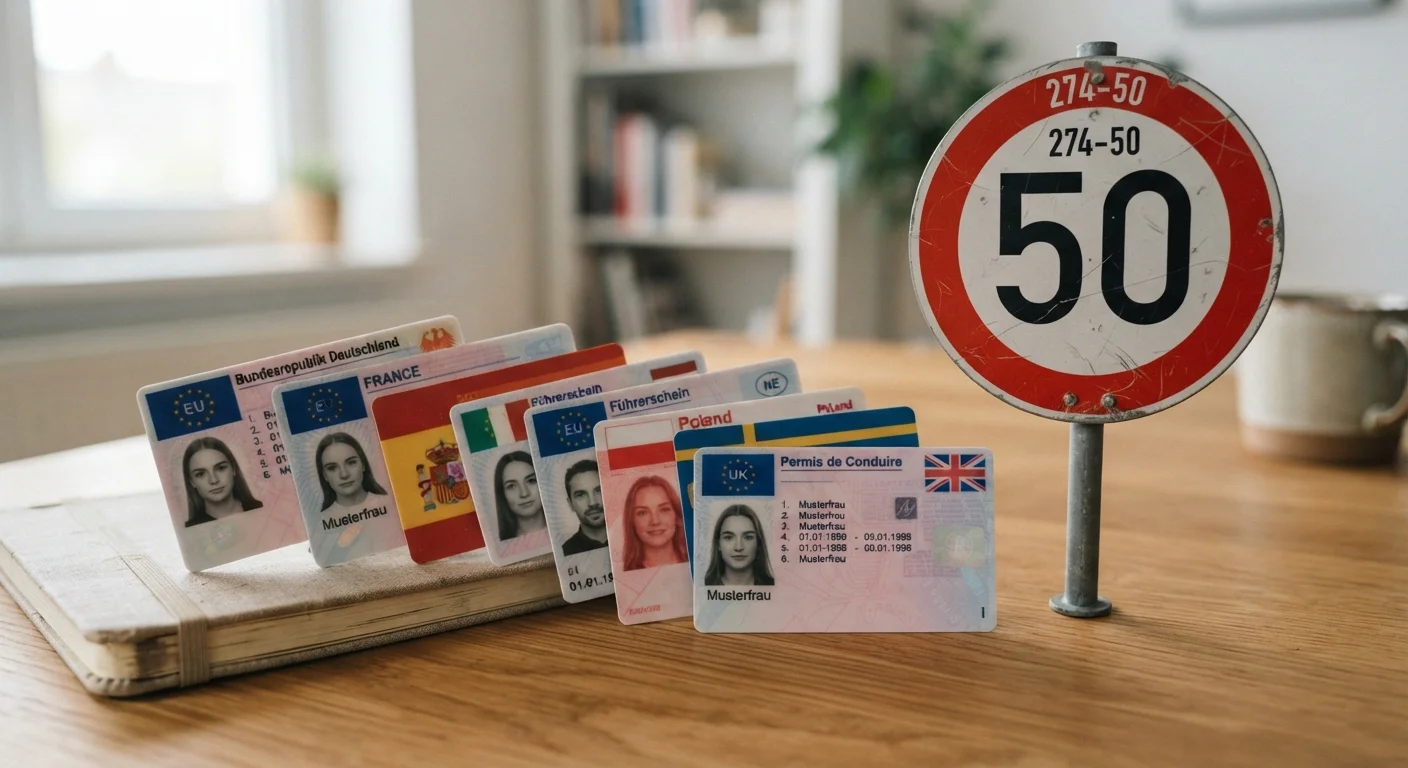
The German term for a driving licence. Since 2013, Germany issues the EU-format plastic card (Kartenführerschein) to all new applicants, replacing the older grey paper licences.
StVZO
Straßenverkehrs-Zulassungs-Ordnung - Germany's Road Traffic Licensing Regulation, which sets out the technical and administrative requirements for vehicles and their permitted use on public roads.
Fahrerlaubnisverordnung (FeV)
Germany's Driving Licence Regulation, which defines the individual licence categories, their age requirements, medical standards, and entitlements for drivers.
Klasse / Class
The German word for a licence category. Each Klasse specifies which types of vehicle a holder is legally permitted to operate on public roads.
Begleitetes Fahren (BF17)
Supervised driving from the age of 17, a German programme allowing learners to drive accompanied by an approved adult before obtaining an independent licence at 18.
Code 96
An EU harmonisation code added to a Category B licence that permits towing a trailer between 3,500 kg and 4,250 kg combined weight, without requiring a full BE licence.
Class B - The Everyday Car Licence
Class B is Germany's standard passenger vehicle licence. It covers cars and vans with a gross vehicle weight (GVW) up to 3,500 kg and seating for up to 8 passengers (plus the driver). A standard B licence permits towing a trailer up to 750 kg. For trailers between 750 kg and 3,500 kg (combined train weight), a BE endorsement is required - unless the driver holds Code 96, which extends the combined limit to 4,250 kg after a short approved training course.
Germany's BF17 programme allows learners from age 17 to drive accompanied by a qualified adult, gaining practical experience before converting to a full independent licence at 18.
Motorcycle Classes - A Progressive Ladder
- AM: Mopeds and light quadricycles up to 45 km/h; minimum age 16.
- A1: Motorcycles up to 125 cc / 11 kW; minimum age 16.
- A2: Motorcycles up to 35 kW; minimum age 18. Access to full A is possible after 2 years.
- A: All motorcycles without restriction; minimum age 24 (or 20 via the A2 pathway).
Classes C and CE - Heavy Goods Vehicles
Class C covers lorries over 3,500 kg GVW with up to 8 passenger seats. Class CE adds the right to tow a trailer over 750 kg. The C1 sub-class applies to vehicles between 3,500 kg and 7,500 kg - a common category for larger vans and ambulances. Professional HGV drivers must also hold a Driver Certificate of Professional Competence (CPC) under EU Regulation 2003/59/EC.
Classes D and DE - Passenger Transport
Class D authorises driving buses with more than 8 passenger seats. D1 is a restricted version, limited to minibuses of up to 16 passenger seats and a GVW no greater than 5,000 kg. As with C categories, the E suffix permits trailer combinations. Professional bus drivers require the Driver CPC alongside the D licence.
Understanding which licence you hold - and what it genuinely permits - matters whenever you rent a larger vehicle, tow a caravan, or consider driving on different types of German roads.
EU Harmonisation: What Changed in 2013
Since January 2013, all EU member states - including Germany - issue a standardised plastic driving licence card (credit-card format) under EU Directive 2006/126/EC. Category codes, entitlements, and renewal cycles are aligned across the bloc. Older German paper licences remain legally valid for driving in Germany and most EU countries, but holders may wish to exchange them for the modern format voluntarily. Always verify current rules with the Kraftfahrt-Bundesamt (KBA) or your local Führerscheinstelle.