
Why the Label Wording Matters
Standing in the drinks aisle, it's easy to treat the words "juice," "nectar," "fruit drink," and "smoothie" as interchangeable. They are not. In the European Union - and by extension in Germany - these terms are defined in law, meaning manufacturers cannot use them arbitrarily. Understanding what each designation signals lets you make faster, more accurate decisions at the shelf.
If you've ever wondered why misreading drink labels is one of the most common nutrition errors people make, this is a large part of the reason: the wording looks similar, but the contents can differ substantially.
The Four Key Designations Explained
Fruit Juice (Fruchtsaft)
Fruit juice is the strictest category. Under EU Directive 2001/112/EC (updated by Directive 2012/12/EU), a product labelled Fruchtsaft must be made entirely from fruit, with no added sugar, no added water, and no artificial flavourings permitted. It may be produced directly from fresh fruit ("directly pressed") or from concentrate that is reconstituted with water to restore the original water content. If the latter, the label must state "made from concentrate." Vitamin C may be added for technical reasons, and this must be declared.
Fruit Nectar (Fruchtnektar)
Nectar is a middle tier. It is made by blending fruit juice or purée with water and, in most cases, added sugar or honey. EU regulations specify minimum juice or purée content by fruit type - for example, at least 50% for fruits like oranges and apples, but as low as 25% for acidic or very intensely flavoured fruits like passion fruit or blackcurrant. This means a mango nectar and an orange nectar can differ significantly in actual fruit content while both carrying the word "nectar."
Fruit Juice (Fruchtsaft)
A drink made entirely from fruit with no added sugar, water, or artificial flavourings permitted. It may be made directly from fruit or reconstituted from concentrate.
Fruit Nectar (Fruchtnektar)
A blended drink combining fruit juice or purée with water and typically added sugar. Minimum juice content varies by fruit type, ranging from 25% to 50% under EU rules.
Fruit Drink (Fruchtsaftgetränk)
A loosely regulated category requiring only a small fraction of actual juice - often as little as 4-6% - with the remainder being water, sugar, and flavourings.
From Concentrate (aus Konzentrat)
Juice from which most water has been removed during processing and later restored. The label must disclose this method, though it does not inherently indicate lower nutritional quality.
Smoothie
A blended beverage typically made from whole fruit or vegetables, retaining fibre and pulp. There is no legal EU definition, so composition varies significantly by product.
Fruit Drink (Fruchtsaftgetränk)
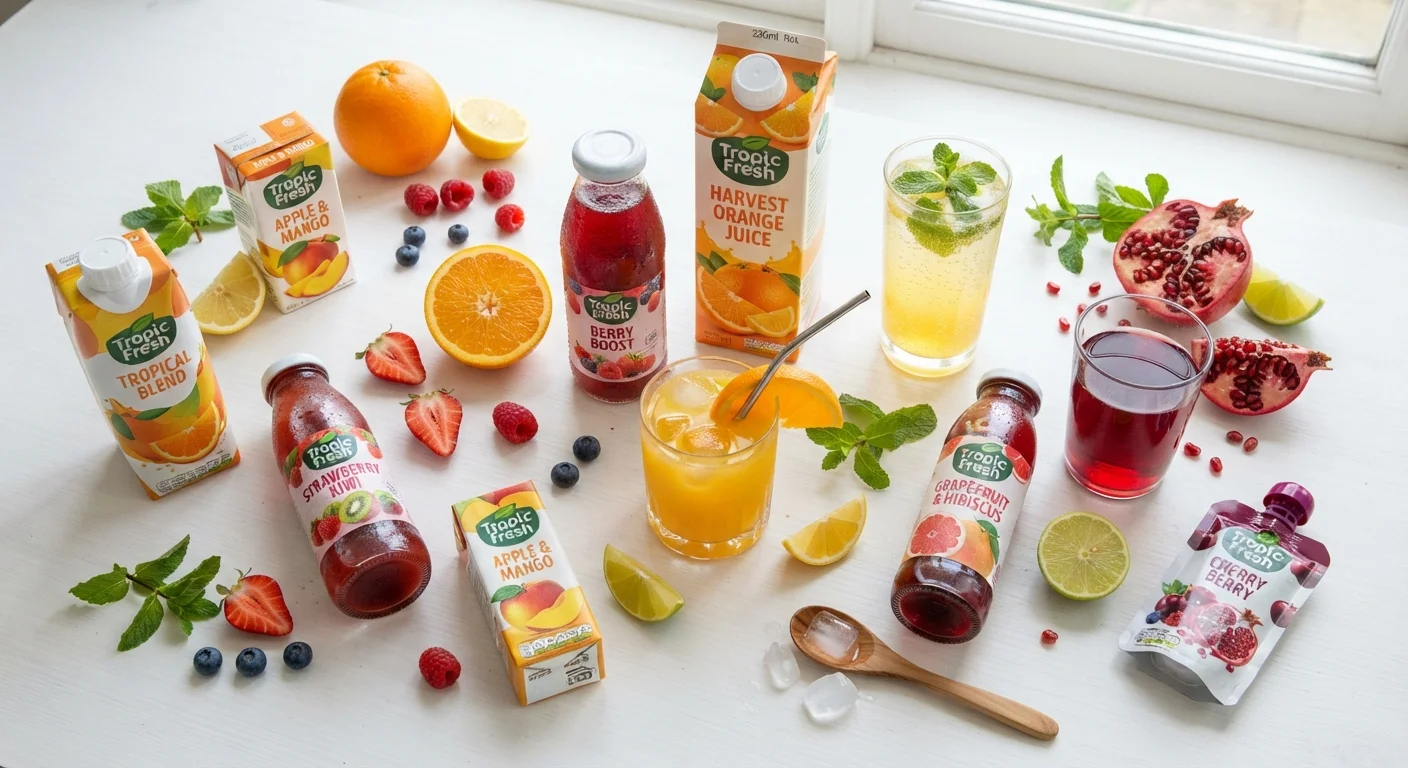
This is the most loosely defined tier. Fruit drinks must contain a minimum of 6% juice - though for citrus varieties this rises to 6% and for some others drops to 4%. The rest is water, sugar, flavourings, and permitted additives. The colourful packaging and fruit imagery can make these products look substantive, but the juice fraction may be minimal. For context on hidden sugars in such products, see how added sugars appear under many names.
Smoothie
Unlike the three categories above, "smoothie" is not a legally defined term under EU food law. Manufacturers use it freely. In practice, smoothies typically blend whole fruit or vegetables - including the fibre-containing pulp - rather than extracting just the liquid. This generally means higher fibre content than equivalent juice volumes. However, without a legal standard, sugar levels, dilution, and ingredient quality vary widely between products. Always check the ingredients list rather than relying on the name alone.
Reading the Label in Practice
Once you understand the tier structure, a few label-reading habits quickly become second nature.
- Check the designation first. Is it "Saft," "Nektar," or "Getränk"? This immediately tells you the minimum fruit content you're getting.
- Look at the ingredients list. Ingredients are listed in descending order by weight. If "water" and "sugar" appear before any fruit component, the fruit fraction is modest.
- Find the juice percentage. German packaging often voluntarily states the exact juice content as a percentage. This is more informative than the category name alone.
- Note reconstitution. "Aus Konzentrat" (from concentrate) is legally required to appear on the label. It doesn't mean the product is nutritionally inferior, but it does indicate a different production process.
A thorough walkthrough of how to interpret all sections of a food label is available in this practical guide to nutrition facts panels.
"Natural" and "Fresh" Are Not Regulated Terms
Words like "natural," "fresh," and "pure" have no standardised legal definition under EU food labelling law for fruit drinks. They are marketing descriptors, not quality guarantees. Always look past these terms to the legal category designation and the ingredients list for accurate information about what's inside.
Smoothies present a specific consideration worth noting. Because blending whole fruit retains fibre, the sugar in a smoothie is delivered alongside fibre - which affects how quickly it is absorbed. However, liquid calories from any source are generally less satiating than solid food equivalents. This is general nutritional context, not a prescription; individual responses vary.