Three Grains, Half the World's Calories
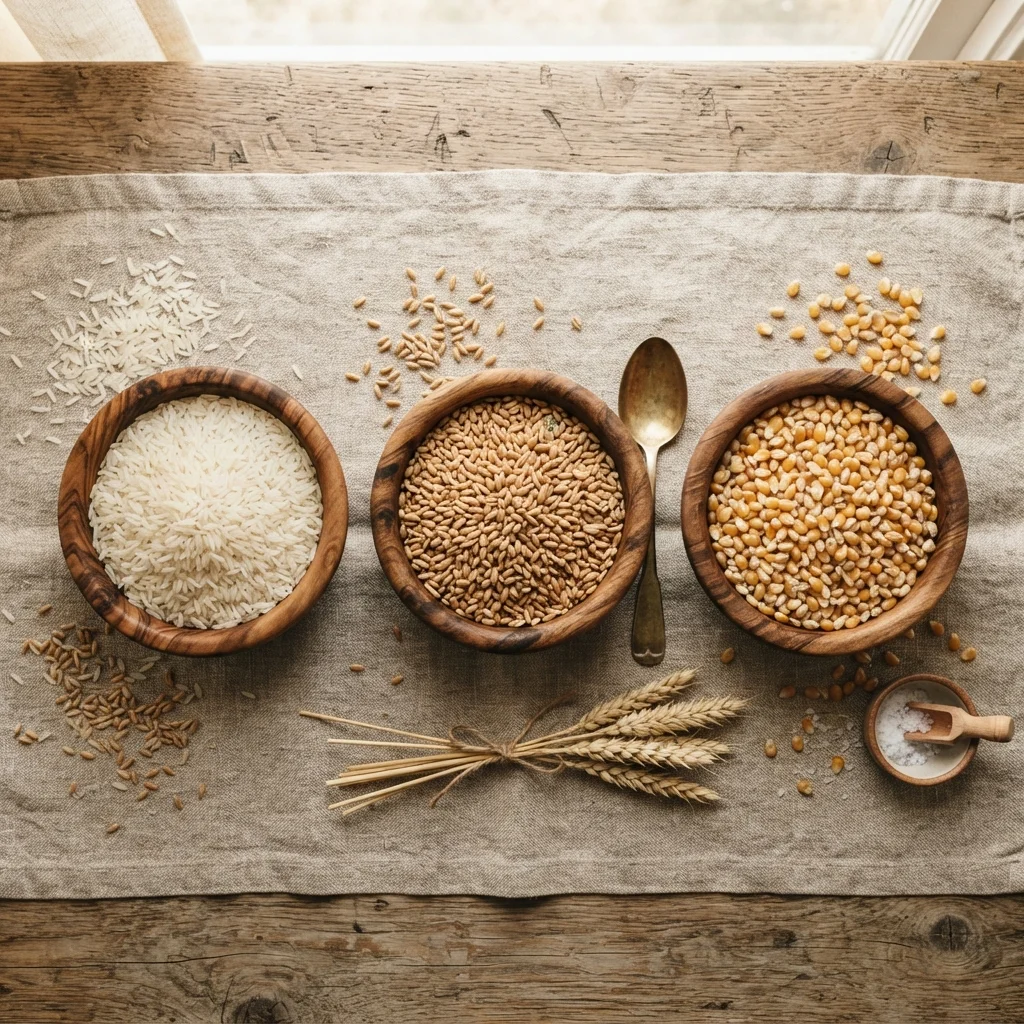
No other category of food has shaped human civilisation more decisively than cereal grains. Rice, wheat, and maize - together with a handful of secondary grains such as sorghum, barley, and millet - provide the majority of calories consumed by people across the globe. Their dominance is not accidental. Each grain suited a particular climate, soil, and agricultural tradition, and over millennia those practical advantages became embedded in cuisine, ritual, and cultural identity.
Understanding why different regions adopted different grains helps explain why food cultures diverge so sharply - and why a bowl of steamed rice, a flatbread, and a corn tortilla can each feel like home to billions of people simultaneously. As trade routes reshaped ancient diets, grains travelled alongside spices and ideas, spreading far beyond their original growing regions.
| Oldest cultivated grain | Einkorn wheat (Fertile Crescent, ~10,000 BCE) (Archaeological consensus, multiple excavation sites) |
| People fed primarily by rice | More than 3 billion (Food and Agriculture Organization of the United Nations) |
| Wheat cultivation area | Largest of any crop by area globally (FAO crop statistics) |
| Maize domestication origin | Southern Mexico, ~9,000 years ago (Genetic and archaeological research) |
| Share of human calories from cereals | Approximately 50% (FAO, The State of Food and Agriculture) |
| Rice varieties in cultivation | More than 40,000 recorded (International Rice Research Institute) |
Rice: The Grain That Built East and Southeast Asia
Domesticated in the Yangtze River basin of China roughly 7,000-9,000 years ago, Oryza sativa - common rice - became the foundation of some of the world's most populous cultures. Wet-field (paddy) cultivation demands cooperative labour to build and maintain irrigation systems, a social structure that many historians argue reinforced the communal, consensus-oriented values visible in many East Asian societies.
In Japan, rice holds near-sacred status: the word for cooked rice, gohan, is also the everyday word for a meal. In parts of South and Southeast Asia, rice varieties number in the thousands, each associated with specific regional dishes, growing seasons, or ceremonial purposes. Even today, rice remains the single most important source of calories for more than three billion people, predominantly in Asia.
Nixtamalisation
A traditional Mesoamerican process of soaking and cooking maize in an alkaline solution, typically limewater. This technique unlocks nutrients - particularly niacin (vitamin B3) - that would otherwise be unavailable to the human body.
Cereal grain
The edible seed of a grass plant from the family Poaceae. Common examples include rice, wheat, maize, barley, oats, and sorghum. Cereal grains are the primary source of dietary energy for most of the world's population.
Gluten
A group of proteins found naturally in wheat, rye, and barley. When flour is mixed with water, gluten forms an elastic network that traps gas bubbles during fermentation, allowing bread to rise.
Paddy cultivation
The method of growing rice in flooded or waterlogged fields, known as paddies. This technique suppresses weeds, regulates temperature, and creates the anaerobic conditions that wet-rice varieties need to thrive.
Fertile Crescent
A crescent-shaped region in the Middle East, encompassing parts of modern Iraq, Syria, Lebanon, Jordan, Israel, and Turkey, widely regarded as one of the earliest centres of agriculture and grain domestication.
Wheat: Foundation of the Fertile Crescent and Beyond
Wheat was among the first crops domesticated during the Neolithic Revolution, originating in the Fertile Crescent - the arc of land spanning parts of modern-day Iraq, Syria, Turkey, and neighbouring regions - approximately 10,000 years ago. Its high gluten content made it uniquely suited to leavened bread, a technology that spread westward through the Mediterranean and northward into Europe, anchoring diets and economies along the way.
The cultural weight of bread in European and Middle Eastern societies is difficult to overstate. In many traditions, bread appears in religious ceremony, hospitality ritual, and proverb. The expansion of wheat cultivation under colonial trade systems further entrenched its global reach, displacing some indigenous staples in the process - a dynamic explored in depth in how empire reshaped food systems worldwide.
Today, wheat is the most widely cultivated grain by area, grown on every inhabited continent and processed into hundreds of distinct food forms.
~50%
Share of global human calories from cereal grains
According to FAO data, cereals collectively supply roughly half of all calories consumed by people worldwide.
10,000 BCE
Approximate date of earliest wheat domestication
Archaeological and genetic evidence places early wheat cultivation in the Fertile Crescent around this period.
40,000+
Documented rice varieties worldwide
The International Rice Research Institute maintains records of more than 40,000 distinct rice varieties.
Maize: From Mesoamerica to a Global Commodity
Maize (Zea mays) was domesticated from a wild grass called teosinte in what is now southern Mexico roughly 9,000 years ago. Pre-Columbian civilisations across the Americas - including the Maya, Aztec, and Inca - built sophisticated agricultural systems, cuisines, and cosmologies around corn. The process of nixtamalisation - soaking maize in an alkaline solution before grinding - was developed in Mesoamerica and dramatically improved the grain's nutritional profile by making key vitamins bioavailable.
After European contact, maize spread rapidly across Africa, Europe, and Asia. In parts of sub-Saharan Africa and southern Europe, it became a staple, though populations who adopted maize without the nixtamalisation technique sometimes suffered from pellagra, a niacin-deficiency disease. This history underscores how food technology and cultural knowledge travel together - or sometimes fail to.
The nutritional patterns shared by cultures that thrive on these grains are explored in our guide on nutritional patterns in healthy diets worldwide. For a closer look at how grain processing affects what you eat today, see whole grains vs. refined grains.
Grain-centred meals also carry a social dimension: the act of sharing rice, bread, or tortillas around a table reinforces bonds that communal eating sustains across cultures.
Secondary Grains Also Shape Regional Identity
While rice, wheat, and maize dominate global calorie supply, secondary grains are central to specific regional cuisines and nutritional systems. Sorghum and millet are critical staples across the Sahel region of Africa. Barley underpins both the brewing traditions of northern Europe and the flatbread cultures of Tibet and Ethiopia. Teff, a tiny grain native to the Horn of Africa, is the foundation of injera, the spongy fermented flatbread integral to Ethiopian and Eritrean communal meals. These grains deserve recognition alongside the 'big three.'