

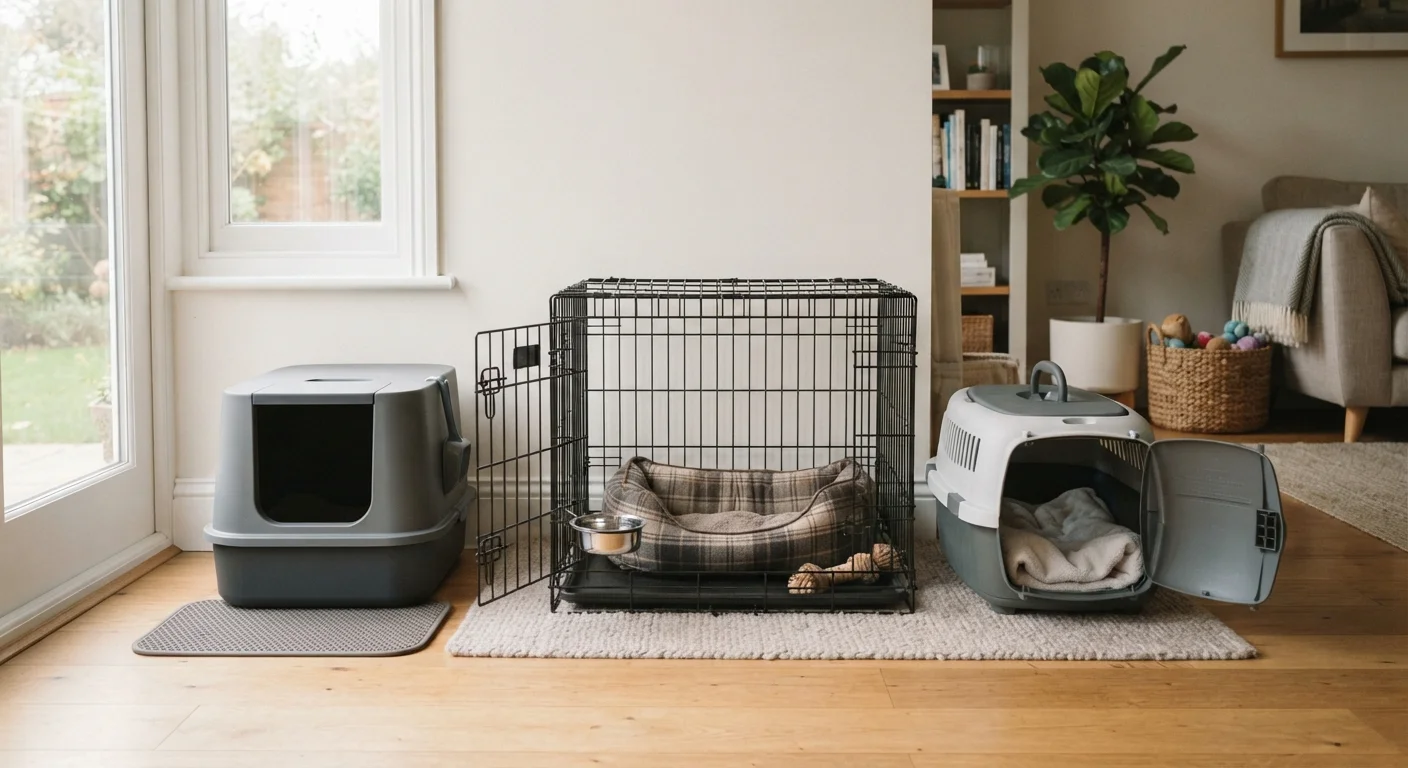
Why These Tools Are Not Interchangeable
Pet owners often treat litter boxes, crates, and carriers as variations of the same idea - a contained space for their animal. In practice, each tool is built around a distinct behavioral principle, and using them interchangeably can erode the very habits they are meant to build.
Understanding what each tool actually teaches is the first step toward using it effectively. For a broader foundation on setting up your pet's early home environment, it helps to understand these tools before they become daily fixtures.
| Litter Box | Crate | Carrier | |
|---|---|---|---|
| Primary behavioral goal | Redirect elimination instinct | Build calm self-regulation | Condition travel tolerance |
| Species most commonly used for | Cats (also rabbits, ferrets) | Dogs primarily | Cats and dogs |
| Learning mechanism | Instinct redirection | Gradual positive conditioning | Association and desensitization |
| Biggest misuse risk | Too few boxes, poor placement | Using as punishment or over-confinement | Only appearing before vet visits |
| Time to establish reliably | Days to weeks | Weeks to months | Weeks with consistent exposure |
| Requires active owner training | Minimal - setup-dependent | Yes - step-by-step introduction essential | Moderate - passive exposure plus reinforcement |
The Litter Box: Leveraging Natural Instinct
Cats are fastidious eliminators by evolutionary design. In the wild, felids bury waste to mask scent from predators and competitors - a behavior ethologists call substrate-directed elimination. The litter box works because it provides the right substrate (loose, granular material) in a consistent location, allowing the cat to perform this instinctive routine reliably.
What the litter box teaches, then, is not a new behavior - it redirects an existing one. The owner's job is largely to make the litter box the most appealing substrate available: clean, appropriately sized, placed away from food, and accessible at all times. Most cats require very little formal training; placement and maintenance do most of the work.
Problems arise when the box is too small, infrequently cleaned, or positioned in a high-traffic area that makes the cat feel vulnerable. These conditions don't signal stubbornness - they signal that the tool has been set up in a way that conflicts with the animal's instincts.
One Simple Litter Box Rule That Changes Everything
Feline behavior researchers consistently recommend one litter box per cat in the household, plus one additional - so two cats need three boxes. This reduces territorial competition and gives each cat a reliable, accessible option. Placing boxes in separate locations, rather than side by side, further reduces the chance of avoidance.
The Crate: Building Tolerance and Self-Regulation in Dogs
Crate training is often misunderstood as simple confinement. Its actual behavioral function is more nuanced: a properly introduced crate teaches a dog to self-settle - to down-regulate arousal and rest calmly without external prompting. This is a learned skill, not an innate one, and it requires gradual, positive introduction.
Dogs are den animals in a limited sense; wild canids do seek enclosed resting spaces, but they are not instinctively drawn to metal enclosures. The crate becomes a positive space only through consistent pairing with calm, rewarding experiences. Puppies introduced to crates with food rewards, short duration increments, and no forced confinement tend to generalize crate comfort into broader emotional resilience.
Critically, the crate should never serve as punishment. Doing so inverts its function - instead of teaching calm, it teaches that the enclosed space predicts distress. This is one reason reading your dog's body language accurately is essential during crate introduction: a dog that appears quiet may be shutting down rather than relaxed.
The Carrier: Conditioning for Calm Transport
Unlike the litter box or crate, the carrier is primarily a transport tool - but its behavioral goal is still specific: it conditions the animal to associate an enclosed, mobile space with neutral or positive experiences rather than fear. For most pets, carriers appear only before veterinary visits, which means they quickly become predictors of stress. This is a conditioning problem, not a temperament problem.
The solution is straightforward but requires consistency: leave the carrier out as a permanent fixture with bedding inside, feed meals near or inside it, and allow the animal to enter voluntarily. Over time, the carrier becomes a familiar resting space rather than an ambush device. Cats especially benefit from this approach, as a carrier they already use voluntarily causes far less cortisol-driven resistance at the vet.
For dogs, the carrier or travel crate serves a similar function, with the added variable of vehicle motion. Gradual desensitization - short trips, positive reinforcement, familiar scents - builds travel tolerance incrementally. The carrier introduction process shifts somewhat as pets age, since senior animals may develop motion sensitivity that requires adjusted strategies.
~58%
Cats showing vet-visit fear linked to carrier
Research published in the Journal of Feline Medicine and Surgery has found that a majority of cats display stress behaviors specifically associated with carrier exposure prior to veterinary visits.
1 in 6
Dogs with separation-related distress
Studies in applied animal behavior estimate that roughly one in six dogs displays some form of separation-related behavior, which crate training - when properly implemented - can help mitigate.
Common Misuses and What They Cost Behaviorally
Each tool carries a specific misuse risk. Litter boxes fail when owners reduce them to one per multi-cat household - the standard guidance from feline behavior researchers is one box per cat plus one additional. Crates fail when they are used to manage an anxious dog for extended periods without addressing the underlying anxiety, effectively intensifying it. Carriers fail when they only appear at high-stress moments.
There is also a tendency to treat these tools as substitutes for enrichment or exercise. A dog spending extended time crated still requires physical and cognitive engagement outside the crate. As explored in the distinction between enrichment and exercise, confinement tools address behavioral regulation - they do not replace the broader needs that keep an animal mentally and physically healthy.
Understanding what each tool is actually designed to teach allows owners to use them with precision - and to recognize when a behavioral problem lies not with the pet, but with the setup.