

Why Life Stage Matters More Than Age Alone
Chronological age is a useful reference point, but it doesn't fully capture where a pet is developmentally. A two-year-old Great Dane is approaching middle age, while a two-year-old Chihuahua is still a young adult. Species, breed size, and individual health history all shape how quickly an animal moves through life phases.
Veterinary and animal welfare organizations generally recognize four broad life stages for dogs and cats: juvenile (puppy or kitten), adolescent-to-young adult, mature adult, and senior. Each stage has distinct physiological needs that influence what you feed, how you exercise, and how often you seek professional guidance. Mismatching care to stage - feeding senior-formula food to a growing puppy, for example - can undermine health rather than support it.
Understanding the behavioral and biological context of each phase allows owners to make informed, proactive decisions rather than responding only when problems become visible.
The Puppy and Kitten Phase: Building Foundations
The juvenile stage is characterized by rapid growth, high caloric demand, and critical windows for socialization. Puppies and kittens require diets formulated for growth - higher in protein and calories than adult maintenance foods - because organ systems, skeletal structure, and muscle mass are all developing simultaneously.
Socialization windows are biologically real. Research in canine ethology identifies roughly 3 to 12 weeks as a sensitive period when puppies are most receptive to forming neutral or positive associations with people, animals, sounds, and environments. Missing this window doesn't doom a pet, but it raises the likelihood of fear-based responses later. Consistent, low-stress exposure during this phase is one of the highest-leverage investments an owner can make.
During the socialization window, prioritize quality of exposure over quantity - one calm, positive encounter with a novel stimulus is more valuable than ten stressful ones.
Ethological research consistently shows that negative experiences during sensitive periods can produce lasting fearful associations, while positive, low-intensity exposures build durable confidence.
Request baseline bloodwork for your pet at their last 'young adult' wellness exam, before any signs of aging appear - this gives your vet a personalized reference point for interpreting future results.
Without individual baseline values, age-related changes in organ function can be difficult to distinguish from within-normal-range variation, potentially delaying recognition of early disease.
Veterinary visits are frequent during this period - typically a series of core vaccinations spaced several weeks apart, plus parasite prevention. Spaying or neutering timing is a topic worth discussing with your vet, as recommendations have evolved and vary by species, breed size, and individual circumstances.
Training tools like crates and carriers introduced calmly during kittenhood or puppyhood tend to be accepted far more readily than when introduced to an anxious adult animal.
Adolescence and Early Adulthood: Managing Peak Energy
Adolescence in dogs typically spans from around 6 months to 2-3 years depending on breed size. This phase is often the most behaviorally challenging: social maturity lags behind physical maturity, and owners frequently report that previously well-behaved animals become selectively unresponsive or more reactive. This is normal neurodevelopment, not regression.
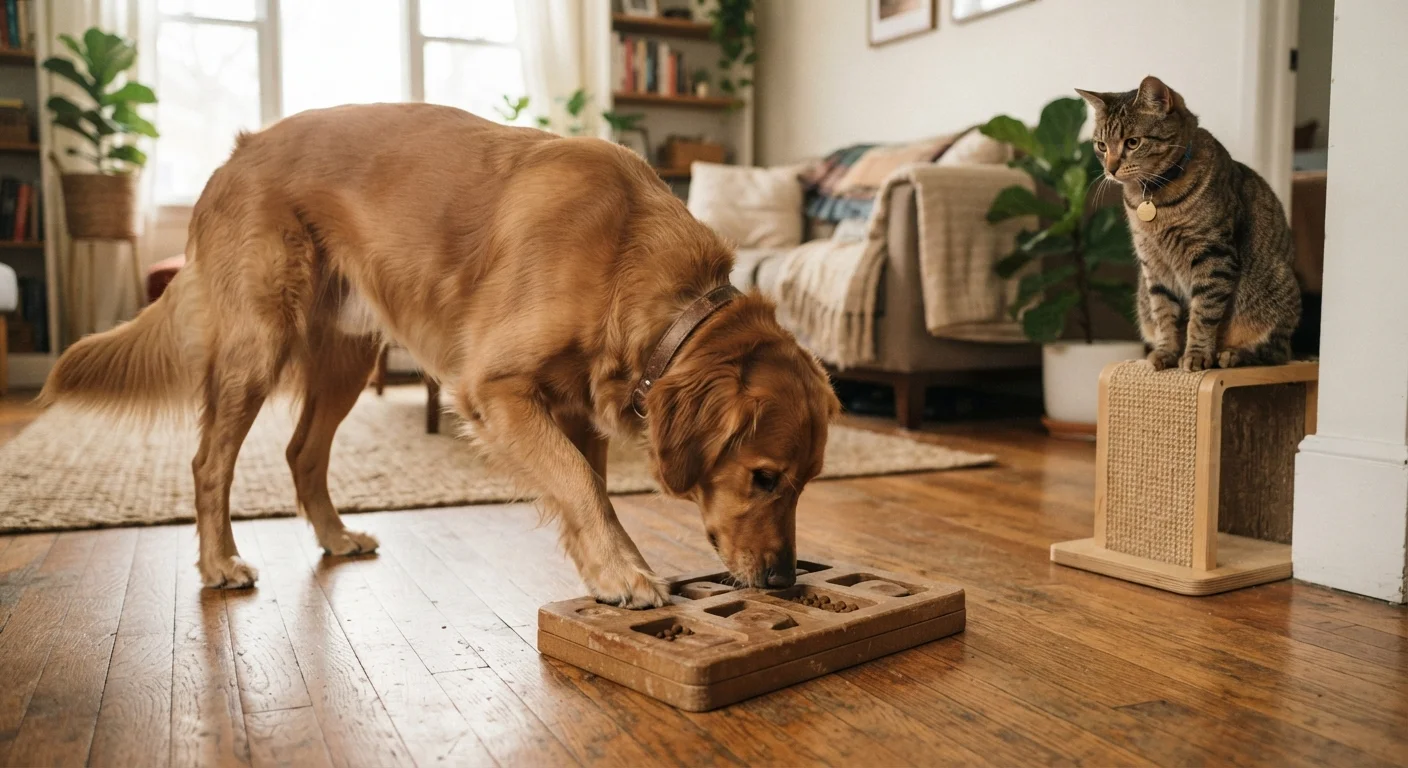
Exercise needs peak during this stage. Mental enrichment and physical exercise serve different functions, and young adults need both in meaningful quantities. A dog that receives long runs but no puzzle-solving or training stimulation may still exhibit destructive behaviors driven by cognitive understimulation.
Over-Exercise in Young Large-Breed Dogs
High-impact, repetitive exercise - long runs on hard surfaces, extensive jumping - during the growth phase can stress developing joint cartilage in large and giant breeds. Consult your veterinarian about appropriate exercise types and durations while growth plates are still open, typically until 12-18 months depending on breed size.
Early adulthood is also when some hereditary conditions - certain joint issues, cardiac anomalies, or metabolic tendencies - begin to manifest. Annual wellness exams during this period establish baseline values that become critical reference points as the animal ages.
Middle Age: Detecting Subtle Shifts Early
For most medium-sized dogs, middle age begins around 5-7 years; for cats, around 7-10 years. This phase often appears uneventful - which is precisely why it's easy to under-monitor. Weight gain, mild dental disease, and early organ function changes frequently begin here, often without overt symptoms.
Dental health deserves particular emphasis at this stage. Periodontal disease is among the most common conditions diagnosed in middle-aged pets, and its effects extend beyond the mouth - chronic oral infection has been associated with cardiovascular and kidney stress in both dogs and cats.
~80%
Dogs with dental disease by age 3
The American Veterinary Medical Association has noted that the majority of dogs show signs of periodontal disease by age three, making early and ongoing dental care a significant welfare concern.
6-7 yrs
Senior threshold for large-breed dogs
Veterinary guidelines generally classify large and giant-breed dogs as senior earlier than smaller breeds, reflecting accelerated aging trajectories in bigger animals.
Owners should watch for subtle behavioral indicators that something has shifted: changes in sleep patterns, slightly reduced enthusiasm for activity, altered appetite, or stress signals that are easy to attribute to personality rather than physical discomfort. See your veterinarian if any of these changes appear.
Senior Years: Comfort, Monitoring, and Adjusted Expectations
Senior designation varies: large-breed dogs may be considered senior at 6-7 years, while small breeds and cats often reach this threshold at 10-11 years. The defining feature of senior care is a shift from prevention to active monitoring combined with comfort optimization.
Mobility changes are common and require practical environmental adaptations - non-slip flooring, lower-entry litter boxes, ramps instead of stairs - rather than simply reduced activity. Pain in senior pets is frequently underreported by owners because animals instinctively mask discomfort; behavioral changes like irritability, reluctance to be touched, or altered gait patterns often signal pain before vocalizations do.
Enrichment remains important even when exercise capacity declines. Scent-based activities, gentle training reinforcement, and calm social interaction support cognitive function and emotional wellbeing in aging animals. Enrichment and exercise are not interchangeable, and this distinction becomes especially valuable when physical limitations narrow activity options.
Cognitive Decline Is a Recognized Condition
Canine cognitive dysfunction (CCD) and feline cognitive dysfunction are veterinary-recognized conditions analogous to dementia. Signs include disorientation, altered sleep-wake cycles, house-training lapses, and reduced social interaction. If you observe these changes in a senior pet, raise them with your veterinarian - several supportive interventions exist, and early identification allows more options.
Nutrition Across the Lifespan
Life-stage-appropriate nutrition is one of the most evidence-supported levers in pet health. Puppy and kitten formulas deliver the caloric density and nutrient ratios required for growth. Adult maintenance foods are calibrated to sustain a stable, active body. Senior formulations often reduce certain minerals and adjust protein profiles to support aging kidneys and joints - though the science here is nuanced and individual variation is significant.
Portion control matters at every stage, but its consequences are most visible in middle age and beyond, when metabolic rate typically declines. Consistent, evidence-based feeding habits - appropriate portions, appropriate frequency, and minimal high-calorie supplementation - underpin health across every life phase. Discuss dietary transitions with your veterinarian, particularly for pets with existing health conditions.
Veterinary Care: How Frequency Should Evolve
The general trajectory is: frequent in youth (initial vaccine series, parasite screening), annual in adulthood (wellness exams, routine labwork), and semi-annual or more in senior years (proactive organ function monitoring, pain assessment, dental evaluation).
Each visit is most productive when owners arrive prepared. Tracking behavioral changes, appetite shifts, and activity levels between appointments gives your veterinarian contextual data that physical examination alone cannot provide. Familiarity with common veterinary terminology also helps owners engage more meaningfully in clinical conversations.
Keep a Simple Pet Health Log
A brief written or digital log noting weekly observations - appetite, energy, elimination habits, any unusual behaviors - takes minutes but provides your veterinarian with invaluable longitudinal data. Patterns that seem minor in isolation can become diagnostically meaningful when documented over weeks or months.
The overarching principle is consistency: animals whose care is actively managed across all life stages rather than addressed reactively when problems emerge tend to show better health outcomes over time. Understanding each stage equips owners to be genuinely proactive partners in their pet's long-term wellbeing.