
The Logic Behind the System: Shape Before Symbol
Before decoding any individual sign, it helps to understand the underlying grammar that makes the system work. Germany organises road signs by shape and background colour, allowing a driver to classify a sign in a fraction of a second - before the brain fully processes the symbol inside.
This visual hierarchy is not accidental. It reflects the requirements of the StVO and mirrors the principles of the 1968 Vienna Convention, meaning the core logic transfers across most of Europe. There are five broad categories every driver should internalise:
- Warning signs: Red-bordered equilateral triangles pointing upward, white or yellow background.
- Prohibitory and restrictive signs: Red-bordered circles, white background - these impose limits or bans.
- Mandatory signs: Blue circles - these require a specific action or route.
- Informational and directional signs: Blue or green rectangles for motorways and main roads, white rectangles for local roads.
- Priority signs: Unique shapes - the yellow diamond for priority road and the inverted red-and-white triangle for yield - that stand apart from every other category.
Understanding this structure means even an unfamiliar symbol can be roughly interpreted: a red-bordered circle always means a restriction of some kind, regardless of what's drawn inside it.
648
Official sign types in the German StVO annexes
The StVO and its administrative annexes define hundreds of individual sign symbols, supplementary plates, and markings, making it one of Europe's most comprehensive traffic sign catalogues.
1968
Year of the Vienna Convention on Road Signs
Germany is a signatory to the 1968 Vienna Convention, which harmonises the basic shape and colour logic of road signs across participating European and non-European nations.
~13,600
Road kilometres on the German Autobahn network
According to the Federal Highway Research Institute (BASt), Germany operates one of the world's longest motorway networks, where consistent sign literacy is critical for safe high-speed driving.
Warning Signs: Anticipating Hazards
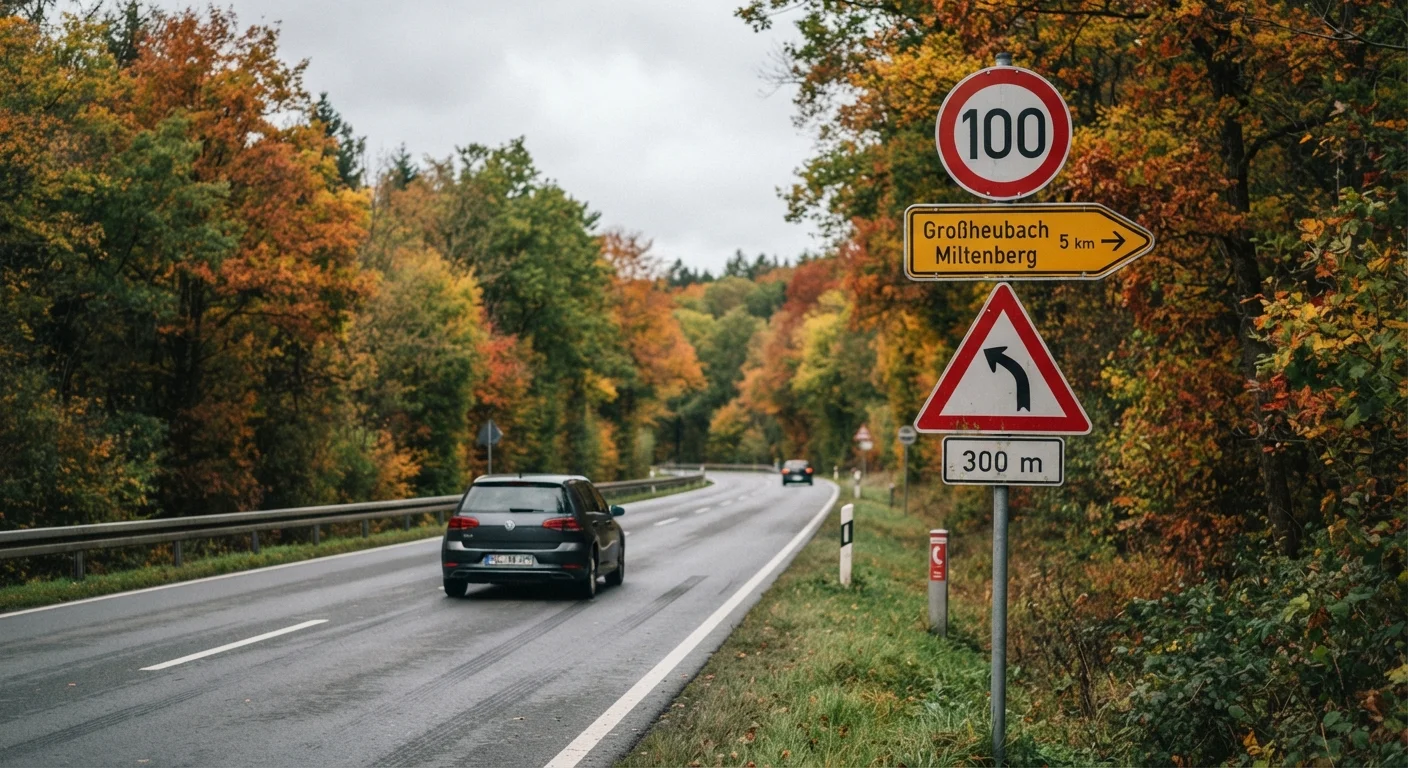
Warning signs use an upward-pointing equilateral triangle with a red border on a white background. The symbol inside communicates the specific hazard - a skidding car for a slippery road, a falling rock silhouette for loose stone zones, or a stylised worker for construction areas. These signs are positioned ahead of the hazard, giving drivers time to adjust speed and attention.
Common examples include:
- Gefahrstelle (general hazard): An exclamation mark - used when a specific symbol does not exist for the hazard present.
- Kurve / Doppelkurve (curve / double curve): Curved arrow symbols indicating the sharpness and direction of upcoming bends.
- Bahnübergang (level crossing): An 'X' symbol, often supplemented by striped countdown markers as the crossing approaches.
Warning signs are frequently paired with supplementary rectangular signs below them indicating the distance to the hazard or its extent (e.g., 500 m or auf 2 km). These distance plates are legally binding elements of the sign assembly.
Read the Supplementary Plate First
When approaching an unfamiliar sign assembly, glance at the supplementary plate below before assuming the main sign applies universally. Time windows, vehicle exemptions, and distance limits on the supplementary plate frequently change what the sign actually means for your specific situation and vehicle type.
Prohibitory and Mandatory Signs: The Rules in Circles
Prohibitory signs (red-bordered circles) are among the most legally significant signs on German roads. Breaching them constitutes a direct violation of the StVO. The most familiar examples are speed limit signs - a black number on a white background inside a red ring. Others include the Überholverbot (no-overtaking, showing two cars side by side) and the Einfahrt verboten (no entry, a plain red circle with a white horizontal bar).
These restrictions end either at a corresponding cancellation sign - a white circle with a grey diagonal band - or at the next intersection unless otherwise indicated.
Mandatory signs (solid blue circles) flip the logic: they instruct drivers what they must do. A blue circle with a white straight arrow requires travel in that direction. A blue circle with a bicycle pictogram designates a mandatory cycle lane. The Mindestgeschwindigkeit (minimum speed) sign - a blue circle showing a number - is notably counterintuitive for drivers used to only seeing maximum limits.
For a thorough understanding of how these restrictions interact at intersections and roundabouts, see Right of Way in Germany: Intersections, Roundabouts, and Trams.
Directional, Informational, and Temporary Signs
Directional signs use colour to communicate road hierarchy. Blue rectangular signs serve motorways (Autobahn), while green rectangles are used on Kraftfahrstraßen (expressways) and federal roads in some contexts. White rectangular signs cover local roads and town centres. Yellow signs with black text denote Umleitungen (diversions).
Temporary traffic management signs - distinguished by a yellow or amber background - appear during roadworks and legally supersede the equivalent permanent signs. A yellow speed limit sign of 60 km/h overrides a standard 100 km/h sign for the duration of the works zone, and enforcement cameras in these sections are common.
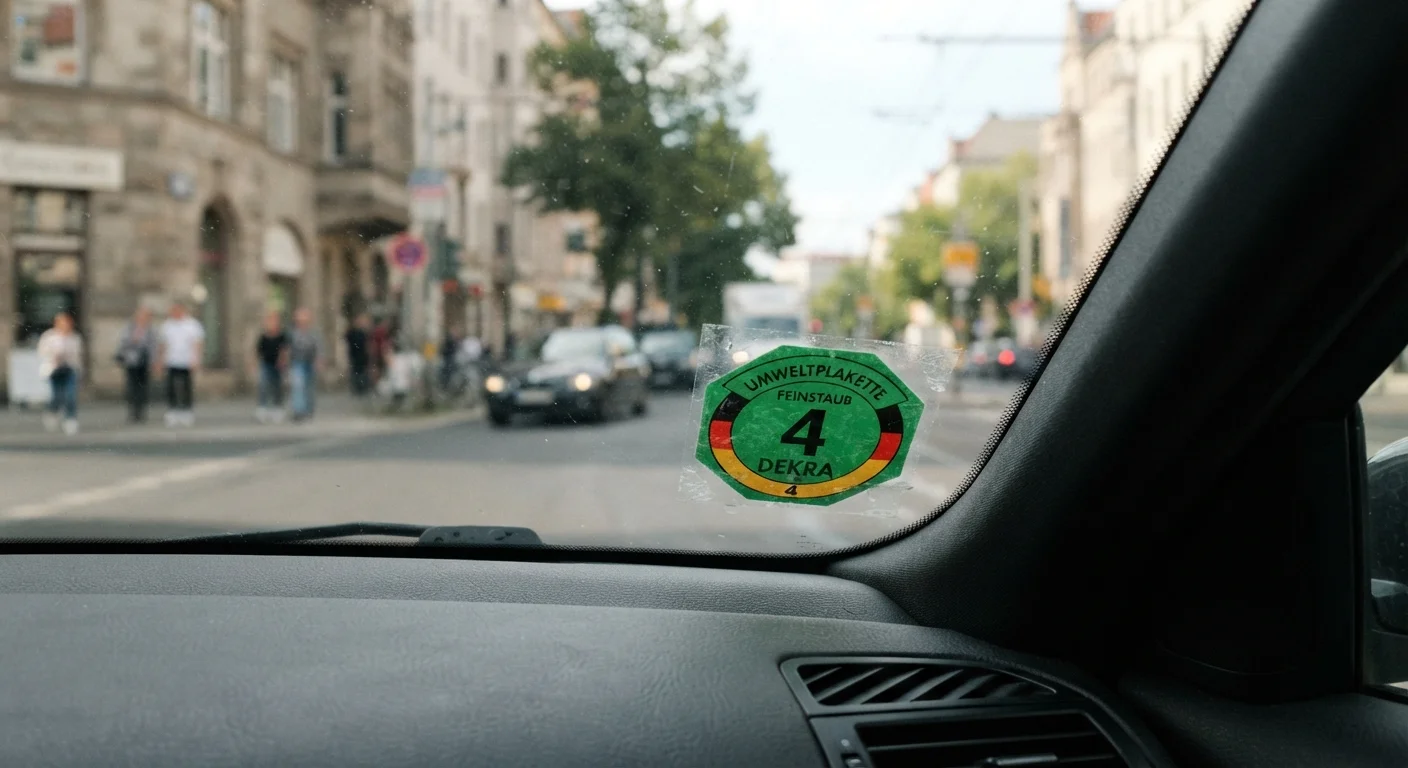
One category that often trips up international drivers is the Umweltzone (environmental zone) sign - a white circle with coloured vehicle silhouettes indicating which emissions classes may enter. Germany's Umweltplakette system ties directly into these signs. For a full explanation, see What the Umweltplakette (Environmental Badge) Means for Drivers.
Temporary Signs Override Permanent Ones
German traffic law is explicit: a yellow temporary sign legally supersedes any permanent sign of the same category for the duration of its deployment. This is a common source of confusion in construction zones. Always treat the yellow sign as the current applicable rule, even if a permanent sign with a different value remains visible nearby.
Supplementary Plates and Sign Combinations
Many German road signs are accompanied by Zusatzzeichen (supplementary plates) - smaller rectangular signs mounted directly below the main sign. These plates refine the scope or conditions of the primary sign's instruction. Common supplementary information includes:
- Time restrictions (e.g., Mo-Fr 7-19 Uhr - valid Monday to Friday, 7 a.m. to 7 p.m.)
- Vehicle category exceptions (e.g., Anlieger frei - access permitted for residents)
- Distance or length indicators for zones
- Wet-weather conditions (bei Nässe) activating a lower speed limit
Reading the combination of main sign and supplementary plate together is essential - misreading one element can lead to an unintentional violation. This is particularly relevant for parking restrictions, where a single sign assembly may encode several overlapping rules across different vehicle types and time windows.
Drivers new to Germany or returning after time abroad will also benefit from reviewing The German Driving Licence Categories Demystified, as certain signs apply exclusively to specific licence classes or vehicle types.