
Cycle Paths: Obligation or Option?
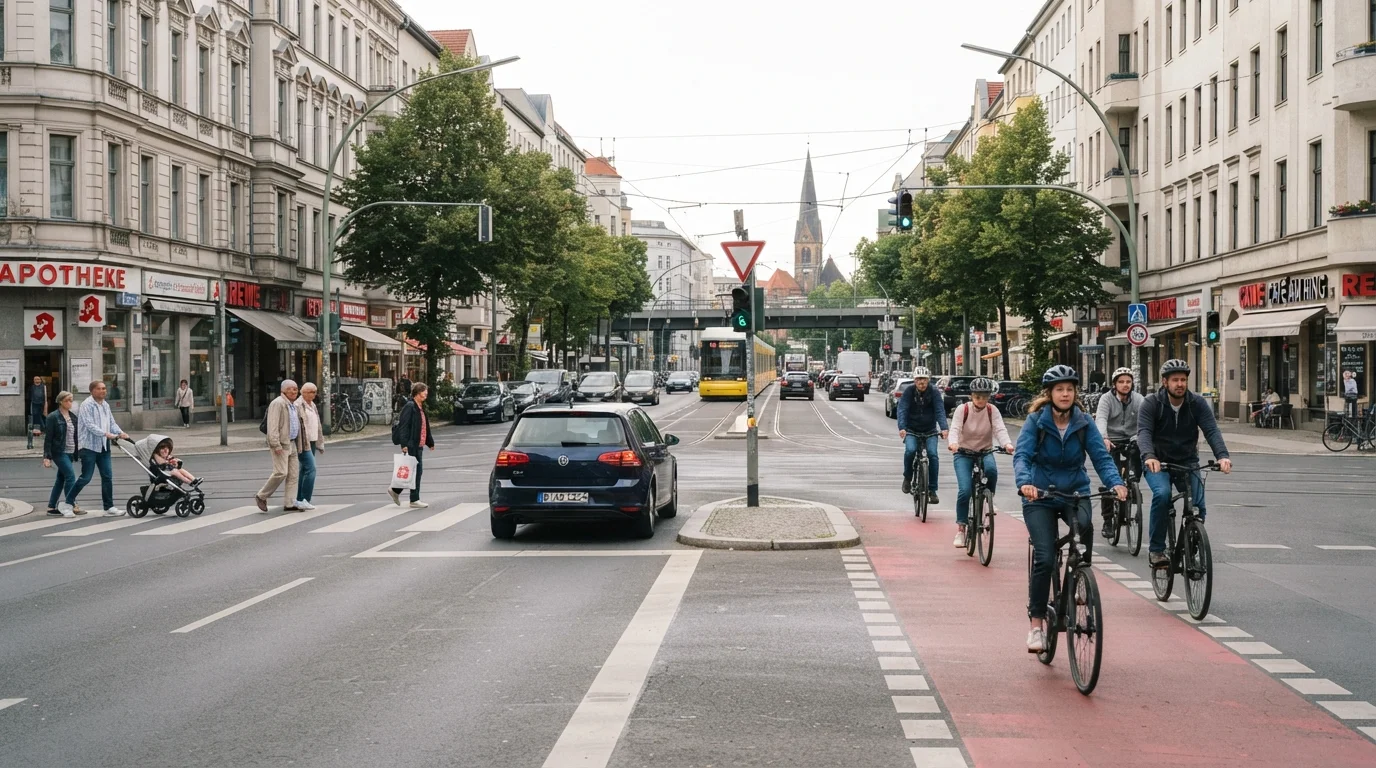
One of the most common points of confusion in German traffic law concerns cycle paths. Not every painted or paved lane near a road carries the same legal weight. A compulsory cycle path is identified by a round blue sign with a white bicycle - cyclists must use it. An advisory cycle path (Schutzstreifen or dashed-line lane) carries no legal obligation, though using it is generally sensible for safety.
Where a compulsory path exists, cyclists must use it regardless of its surface condition or width, unless it is temporarily obstructed. Drivers, in turn, must not park or drive on any designated cycle facility - doing so obstructs what is legally the cyclist's space and carries fines under the StVO.
For a broader look at how road rules change depending on where you drive, see city versus rural driving differences in Germany.
Check the Sign Before Assuming
Before concluding that a cyclist is in the wrong for not using a nearby path, look for the round blue compulsory sign. If it is absent, the path is advisory and the road is the cyclist's legal right. Assuming otherwise leads to unnecessary horn use, intimidation, and potential traffic offences on the driver's part.
Overtaking Cyclists Safely and Legally
Since reforms to the StVO came into effect, the minimum lateral clearance when overtaking a cyclist has been legally specified: 1.5 metres inside built-up areas and 2 metres outside them. This applies to all motor vehicles, including motorcycles. Passing a cyclist within these minimums is a traffic offence, with fines starting at €80 and a point on the Fahreignungsregister (driving record) for more serious violations.
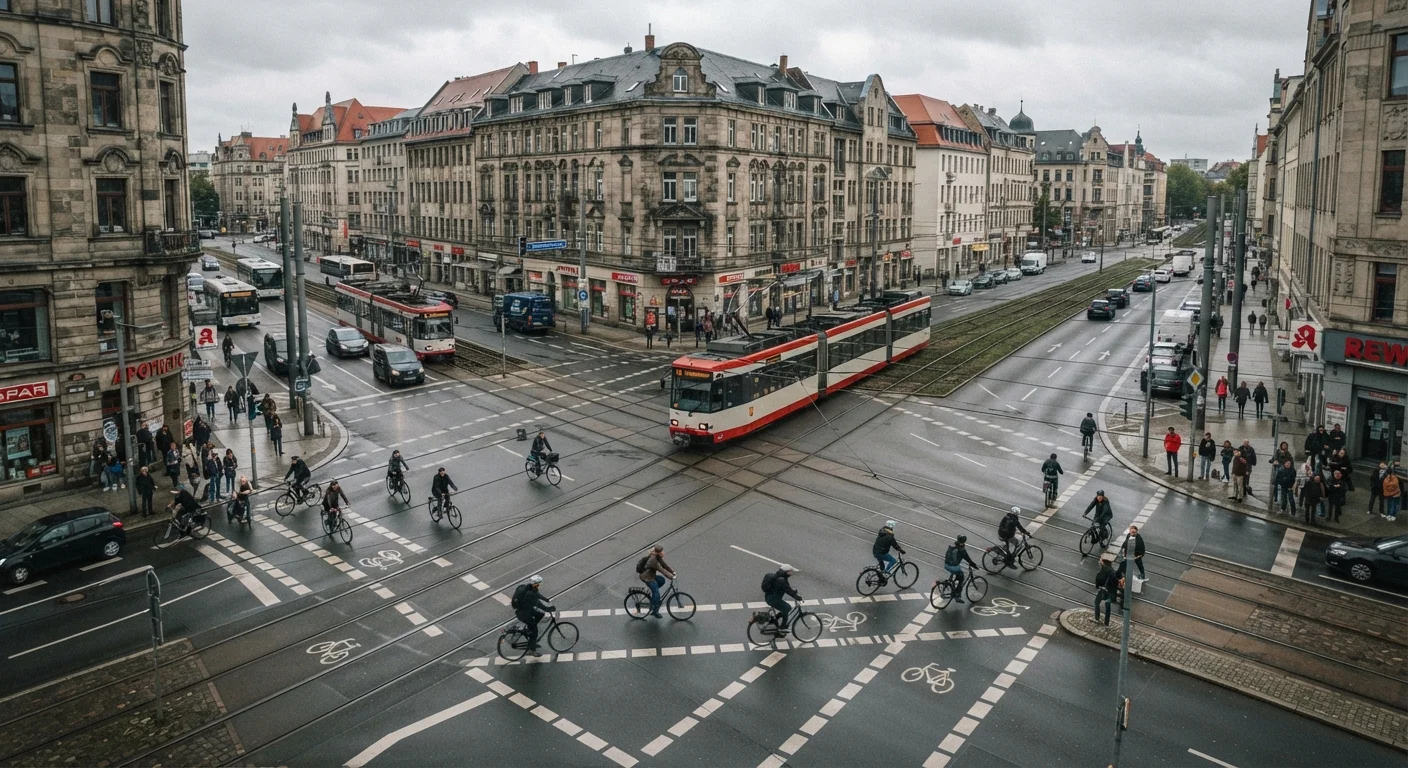
In practice, this means drivers should treat overtaking a cyclist similarly to overtaking a slow vehicle - changing lanes where safe, rather than squeezing past in the same lane. If there is insufficient space to pass with the required clearance, the law requires waiting until the road ahead is clear.
1.5 m
Minimum overtaking clearance for cyclists in towns
Mandated under the 2020 StVO reform; violations begin at €80 with possible points on the driving record.
~34%
Share of serious urban accidents involving cyclists
According to Statistisches Bundesamt data, a significant proportion of serious urban road accidents involve cyclists, underscoring the importance of driver awareness.
Newly licensed drivers are particularly prone to misjudging these distances. Common errors made by first-year drivers in Germany covers this and other frequently misunderstood situations.
Pedestrian Priority: Zebra Crossings and Shared Zones
Under §26 StVO, pedestrians have absolute right of way at marked pedestrian crossings (Zebrastreifen). The duty on drivers is active, not passive: once a pedestrian steps onto the crossing - or signals a clear intention to cross - the driver must stop. Courts have consistently upheld that slowing to assess the situation is insufficient; coming to a full stop is required.
Shared zones and residential play streets (Spielstraßen) operate under similarly strict pedestrian priority. In a Spielstraße, vehicles must travel at walking pace and may not block pedestrian movement. Children playing in the road have explicit legal protection; drivers are required to proceed with extreme caution and, if necessary, stop and wait.
In Shared Space designs - increasingly common in German city centres - all road markings, kerbs, and signals are removed to encourage negotiated movement between users. These areas require heightened attention from all parties, as no single user has automatic mechanical priority.
Right of Way at Intersections Involving Cyclists
When a cyclist travels along a cycle path that crosses an intersection, right-of-way rules can be complex. Generally, a cyclist on a compulsory cycle path running parallel to a road inherits the road's priority at the intersection. However, if the cycle path is separately routed and crosses the road at a different angle, standard junction rules apply. For a detailed breakdown, see right of way rules at German intersections and roundabouts.
Pavement Parking: A Frequently Misunderstood Prohibition
Germany's StVO prohibits parking on pavements as a default rule. Many drivers assume that if a vehicle fits on the pavement without blocking pedestrian flow, it is acceptable - this is incorrect. Pavement parking is unlawful unless a sign (specifically, a parking sign combined with a pavement symbol) or a road marking explicitly authorises it for that location.
Fines for pavement parking were raised as part of the 2020 StVO reform, with vehicles that obstruct pedestrian paths - particularly those used by wheelchair users or parents with pushchairs - subject to towing in addition to the fine. Local authorities have discretion over enforcement intensity, but the underlying prohibition is uniform across Germany.
For drivers also managing the costs of car ownership, understanding traffic fines and their points implications is part of the broader picture covered in practical car ownership guidance.