
Why Motorway Breakdowns Demand a Different Approach
Breaking down on a German Autobahn is categorically more dangerous than stopping on an ordinary road. Traffic routinely travels at 130 km/h or above on unrestricted sections, and stopping distances at those speeds exceed 100 metres even under good conditions. Secondary collisions - in which a moving vehicle strikes a stationary one or a person standing near it - account for a disproportionate share of motorway fatalities in Germany each year.
German road traffic law (the StVZO and the StVO) sets out specific obligations for drivers whose vehicles become immobile on the motorway. These are not suggestions: failure to place a warning triangle, wear a reflective vest, or correctly signal a breakdown can result in a fine and, more importantly, places you and other road users at serious risk. Drivers new to German roads should also review common first-year errors that often involve misunderstanding hard-shoulder and emergency-stop rules.
Reflective warning triangle
Required by law to warn approaching traffic of a stationary vehicle on the motorway.
High-visibility reflective vest
Must be worn before exiting the vehicle on a motorway or hard shoulder.
First aid kit
Legally required in all vehicles registered in Germany; available for use in the event of injury.
Fire extinguisher
Not legally mandated for private cars in Germany but strongly recommended for rapid response to engine fires.
Mobile phone (fully charged)
Used to contact breakdown services or emergency services when an SOS phone is not accessible.
Understanding the legal framework and the correct sequence of actions before you are under stress is the most effective preparation. The steps below reflect current StVZO requirements and standard emergency guidance issued by German road safety authorities.
Before You Travel: Required Equipment
Every vehicle on a German motorway must carry three items as a matter of law: a warning triangle, a reflective vest, and a first aid kit. These should be accessible without digging through luggage - ideally the vest in the door pocket or glove box, and the triangle near the top of the boot. Stowing them correctly saves critical seconds during a real breakdown.
What you will need
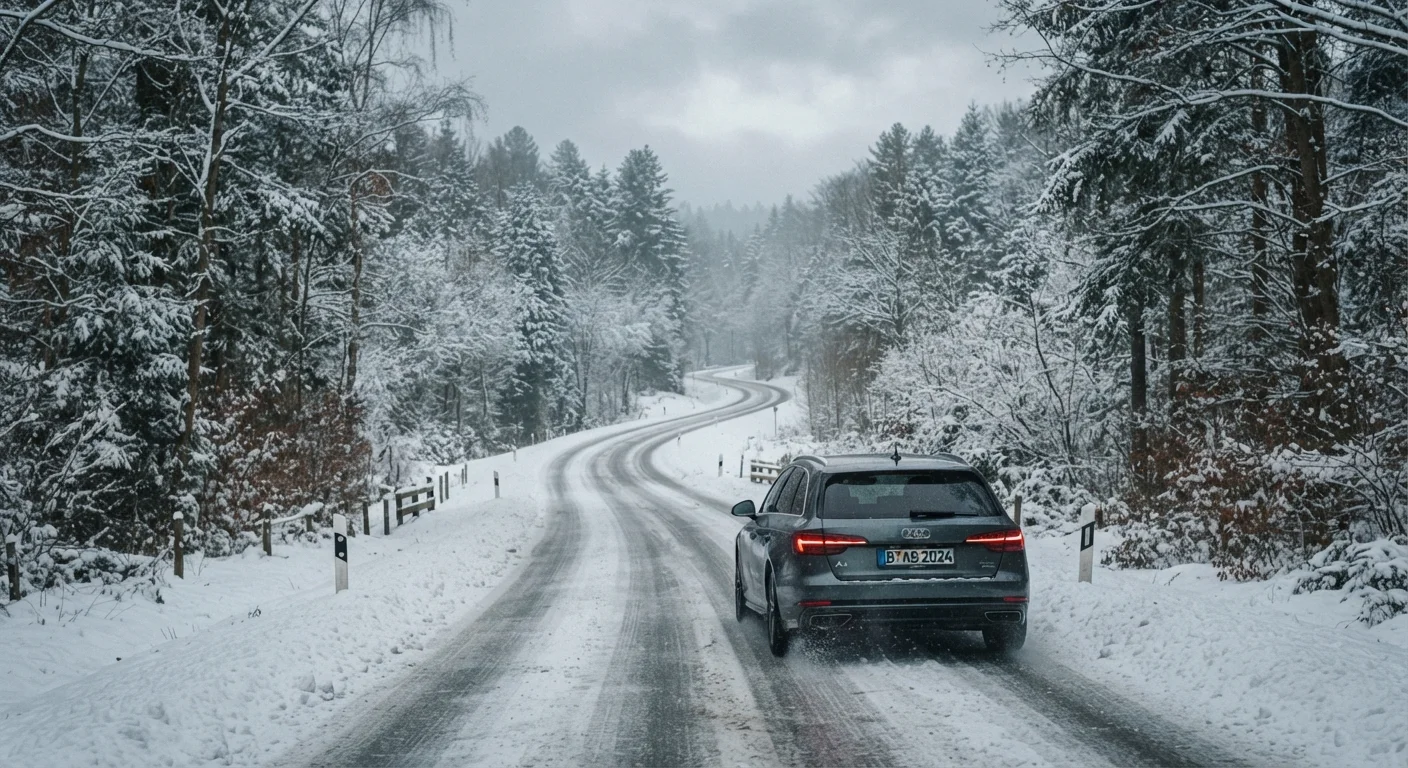
For winter journeys, tyre condition takes on additional legal relevance. Germany applies situational winter tyre rules rather than fixed calendar dates - understand exactly when winter tyres are legally required before travelling in cold or icy conditions, as a tyre failure on icy roads significantly raises the likelihood of a motorway stop.
Reflective Vest Is Mandatory
Since 2014, every vehicle registered in Germany must carry at least one high-visibility reflective vest (EN ISO 20471 standard). You are legally required to wear it before exiting the vehicle on a motorway. Failing to carry a vest can result in a fine. If travelling with passengers, carry one vest per person if possible.
Step-by-Step: Managing a Motorway Breakdown
Follow these steps in sequence. Each action is ordered to maximise your safety and comply with German legal requirements. If you are travelling with others, assign one person to manage passengers while you handle the triangle - do not leave children or animals unattended near the carriageway.
Activate hazard lights immediately
The moment you sense a problem - an unusual sound, a sudden loss of power, a flat tyre - switch on your hazard warning lights without delay. This signals to drivers behind you that something is wrong and gives them additional reaction time. Keep the hazard lights on for the entire duration of the breakdown.
Move to the hard shoulder or emergency bay
Steer the vehicle as far to the right as possible onto the hard shoulder (Standstreifen). Where a hard shoulder is not available - such as on some urban stretches or sections under construction - drive to the nearest marked emergency stopping bay (Nothaltebucht). Turn the front wheels toward the verge so the car cannot roll into traffic if the brakes fail.
Exit the vehicle safely and move to safety
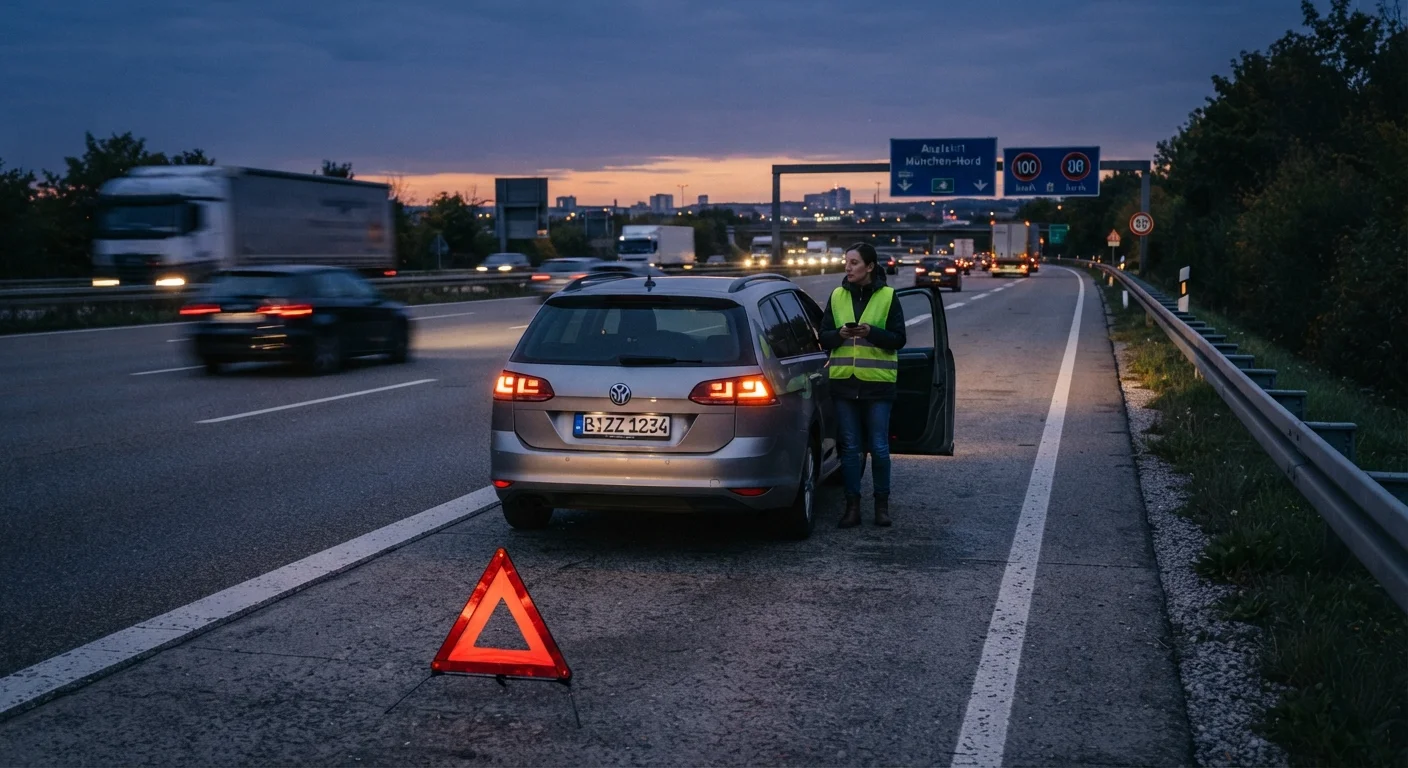
All occupants must exit through the doors on the right-hand (kerb) side only. Before opening the door, check that no motorcyclists or cyclists are passing. Once out, put on your reflective vest immediately. Lead everyone - including animals - behind the safety barrier or as far up the embankment as possible. Do not remain inside the vehicle; a rear-end collision at motorway speed is survivable much more easily away from the car than inside it.
Place the warning triangle
Retrieve the warning triangle from the boot, staying close to the safety barrier as you walk back along the hard shoulder. Place the triangle on the hard shoulder at least 100 metres behind your vehicle - equivalent to roughly 100 large paces. In tunnels, do not use a triangle; rely solely on hazard lights. In rain, fog, or at night, position the triangle further back to give drivers more reaction distance.
Call for assistance
Contact a breakdown service or emergency services. ADAC members can call 0800 5 10 11 12 (free, 24/7). Non-members can reach ADAC's European breakdown service at the same number; assistance is available but chargeable. The pan-European emergency number 112 connects to police and rescue services. When describing your location, reference the nearest kilometre marker (Kilometerstein) visible on the right side of the road, plus the motorway number and direction of travel.
Wait in a safe position
Wait behind the barrier at a point level with your vehicle or slightly ahead of it. Do not re-enter the car while it is on the hard shoulder unless directed by emergency services or in severe weather with no alternative shelter. If a tow truck or road assistance patrol arrives, remain behind the barrier until the operative signals it is safe to approach.
Never Stand on the Motorway Carriageway
Once you and your passengers have exited the vehicle, move immediately behind the safety barrier or as far from traffic as possible. Motorway shoulders carry a significant risk of secondary collisions - German accident statistics consistently show that occupants standing near broken-down vehicles are at serious risk. Under no circumstances should you stand between your car and oncoming traffic.
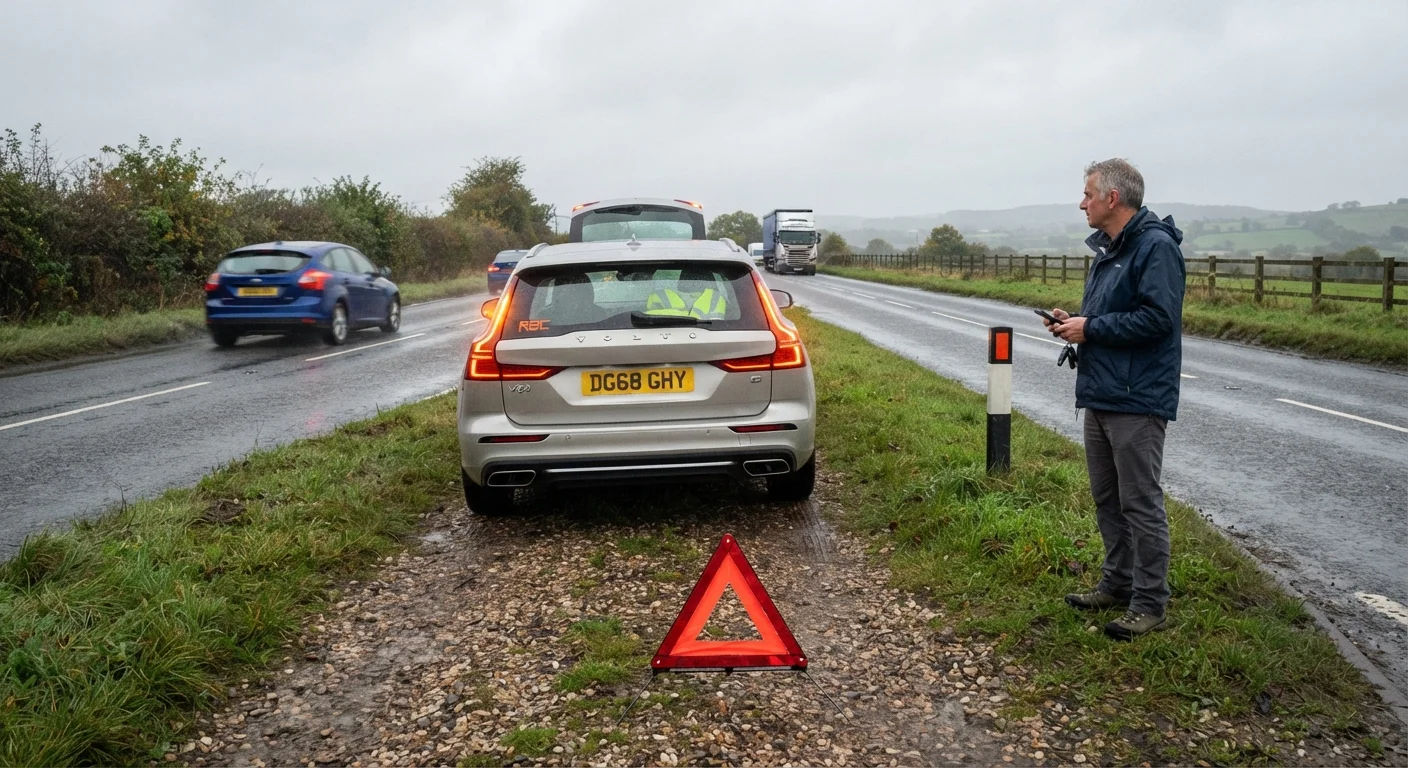
For breakdowns on ordinary roads or dual carriageways rather than full motorways, the procedure shares many elements but differs in triangle placement distance and traffic patterns - see our general roadside breakdown guide for those scenarios.
After the Recovery: Legal and Practical Follow-Up
Once your vehicle has been recovered, you are not legally permitted to drive it on the motorway again until the fault has been properly repaired by a qualified mechanic - not a temporary roadside fix, unless that repair restores the vehicle to a fully roadworthy condition. Returning to the motorway in an unsafe vehicle can constitute a traffic offence under § 23 StVO.
If the breakdown was caused by a crash or another driver's action, document the scene thoroughly before the vehicle is moved: photograph the position, any damage, and relevant road markings. Exchange details under the same obligations that apply in any German road accident.
Use Emergency Phones for Fast Location Data
Orange SOS phones are positioned every 2 kilometres along German Autobahnen and are marked by small arrows on the roadside reflectors. Calling from one automatically transmits your precise location to rescue services, which is faster and more accurate than describing your position by phone. Arrows on the reflector posts indicate the direction of the nearest box.
For a broader grounding in Autobahn-specific rules - including hard-shoulder regulations, lane discipline, and speed advisory obligations - the full Autobahn rules guide covers the legal framework in detail. Staying well-informed before a crisis is, ultimately, the most effective safety measure available to any driver.