
No Leader Required: How Collective Behavior Emerges
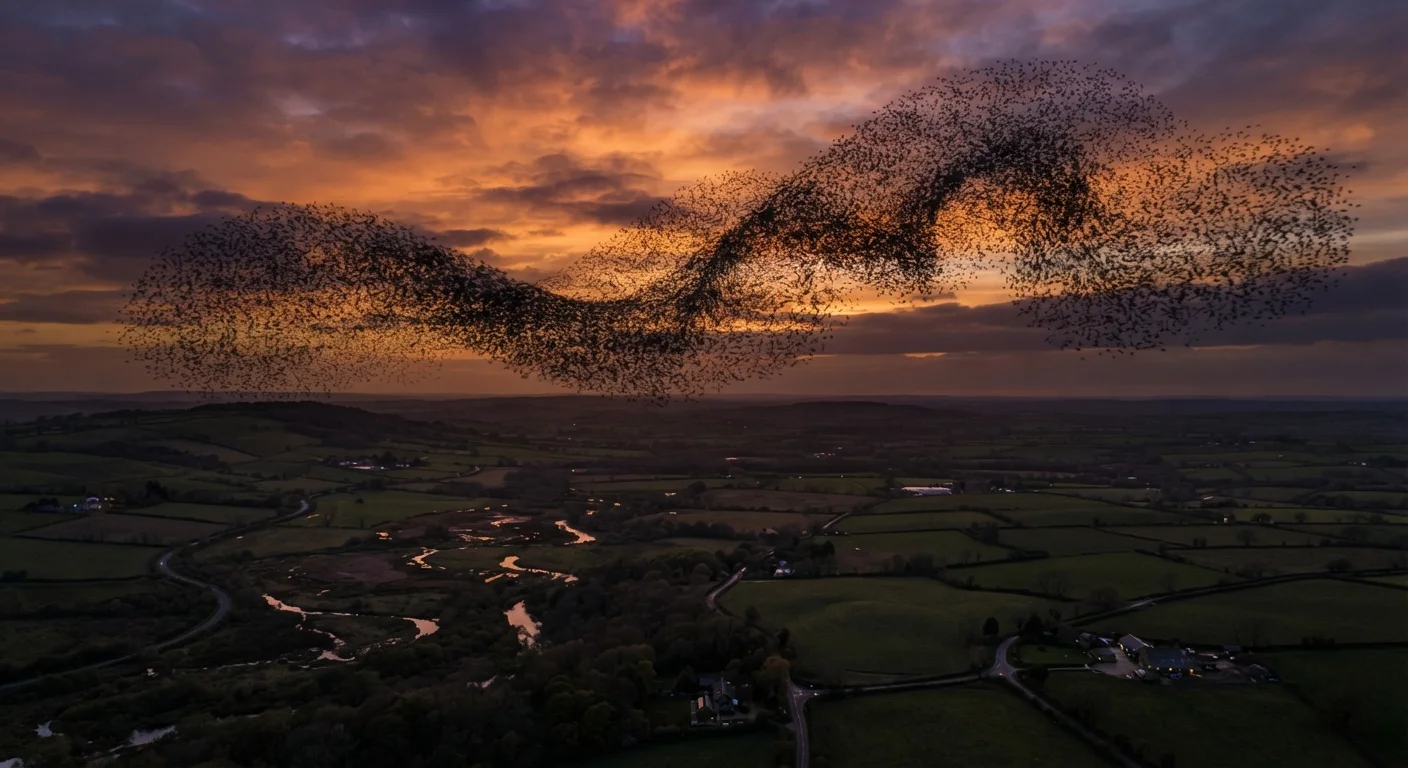
Watch a murmuration of starlings at dusk and the instinct is to search for a conductor - some guiding force orchestrating the rippling, shape-shifting mass. There is none. What appears to be choreography is instead the emergent output of thousands of individuals each obeying the same handful of local interaction rules.
Ethologists and computational biologists have identified three core rules that underpin collective motion across a remarkable range of species:
- Cohesion: Move toward the average position of nearby neighbors.
- Alignment: Match the heading and speed of nearby neighbors.
- Separation: Avoid crowding or colliding with neighbors.
These rules were formalized in Craig Reynolds's influential 1987 simulation model - known as "Boids" - which demonstrated that just these three interaction rules, applied locally, reproduce the fluid complexity seen in real flocks and schools. Subsequent empirical studies confirmed that the model captures genuine biological behavior. Research published in the journal PLOS Computational Biology found that starlings respond most strongly to their topological neighbors (roughly seven nearest birds) rather than those within a fixed radius - an adaptation that keeps the flock cohesive even as density varies.
“Swarm intelligence shows us that cognition need not be centralized. The colony knows things that no individual bee knows - and acts on that knowledge reliably.”
— Thomas Seeley, Professor of Biology, Cornell University, and author of research on honeybee collective decision-making
Fish Schools, Bee Swarms, and Ant Colonies: Variations on a Theme
The same self-organizing logic operates across vastly different taxa, each with its own sensory toolkit.
Fish schools rely on vision and the lateral line system - a row of mechanoreceptive organs running along a fish's body that detects minute pressure waves from neighboring fish. This dual-channel sensing enables schools of sardines or herring to execute near-instantaneous evasive maneuvers when a predator strikes, producing the visually striking "flash expansion" and "fountain effect" behaviors documented in predator-prey studies.
Honeybee swarms demonstrate collective intelligence in decision-making rather than motion. When a colony needs a new nest site, scout bees independently evaluate candidates and perform waggle dances to signal their assessments. Higher-quality sites earn more energetic dances, which recruit more scouts, which inspect and confirm quality - a distributed voting process that reliably selects the best available option. Biologist Thomas Seeley's research at Cornell University has documented this process in rigorous detail.
Army ants collectively construct living bridges from their own bodies, optimizing bridge geometry in real time based on traffic flow - without any supervisor ant overseeing the project. This kind of distributed problem-solving has inspired research in robotics and network design.
For a broader look at how animals exchange information to enable such coordination, see our article on animal communication systems.
~7
Neighbors each starling tracks in a murmuration
Research published in PLOS Computational Biology found starlings use topological rather than metric neighbor rules, maintaining flock cohesion across varying densities.
<0.5 s
Time for a direction change to cross a large flock
Studies of starling murmurations have measured propagation speeds of directional information at approximately 20-40 meters per second across the flock.
20-100+
Individual fish in a school needed for confusion effect
Laboratory predation experiments indicate the confusion effect becomes significant at group sizes above roughly 20 and strengthens with increasing school size.
Why Collective Intelligence Evolved: The Survival Calculus
Collective behavior imposes costs - individuals must remain close to others, share resources, and sometimes defer their own movement preferences. Evolution favors it because the benefits consistently outweigh those costs in ecological contexts where predation pressure is high or food is patchily distributed.
Predator defense is the most documented driver. The confusion effect describes the documented difficulty predators face when targeting a rapidly shifting group, compared with a solitary individual. Studies on fish schools under simulated predation have shown measurably reduced capture rates compared with isolated fish, even when school size is held constant. The dilution effect adds another layer: each individual's statistical probability of being the one caught decreases as group size increases.
Collective foraging offers a parallel advantage. Groups locate food patches faster than individuals, partly because multiple searchers cover more ground and partly because food-finding information spreads rapidly through the group via behavioral cues - a mechanism studied in both bird flocks and social insects.
It is worth noting that collective behavior contrasts sharply with hierarchical social organization. In dominance-based societies, high-ranking individuals direct group behavior. In self-organizing collectives, coordination arises from peer-to-peer interaction with no rank involved. For more on how those rank-based systems work, see our piece on why animals form hierarchies. Similarly, collective living isn't universal - ecological pressures also push many species toward solitary lifestyles, as explored in our look at solitary versus social animals.
Observing Collective Behavior in the Field
Murmurations are most commonly observed in Europe and parts of North America during autumn and winter evenings, typically within an hour of sunset near large roost sites. Fish schools are easily observed in coastal shallows or aquarium settings - watch for the coordinated flash expansion response when the group is startled. Simply tracking which direction information travels (and how fast) can reveal a great deal about local interaction rules.
When Collective Intelligence Fails
Self-organization is robust but not infallible. Army ants are well known for forming circular mills - also called death spirals - in which workers follow each other's pheromone trail in a closed loop, circling indefinitely until exhaustion. This occurs when the trail accidentally loops back on itself and no individual has the information to break the cycle. It is a vivid reminder that collective behavior optimizes for local information, not global awareness.
In fish schools, artificially introduced individuals moving on erratic trajectories can disrupt coordinated responses, demonstrating that the system depends on behavioral consistency among members. Researchers studying collective behavior in noisy or degraded environments have found measurable declines in coordination fidelity - relevant context for understanding how habitat disruption may affect species that depend on collective defense or foraging.
The cooperative logic underpinning group living also connects to questions of apparent altruism - why individuals sometimes act in ways that seem to benefit the group at cost to themselves. Our article on when animal behavior looks altruistic unpacks the evolutionary mechanisms behind those patterns.
Collective Intelligence and Robotics Research
The principles of self-organizing animal collectives have directly inspired swarm robotics - engineering systems in which many simple robots coordinate without centralized control. Applications under active research include search-and-rescue drones, environmental monitoring arrays, and adaptive logistics networks. The biological precedent demonstrates that robust, scalable coordination does not require complexity at the individual level.