
The Evolutionary Logic of the Night Shift
Night is not an absence - it is an ecological opportunity. For a large proportion of the world's vertebrate and invertebrate species, darkness represents a competitive advantage carefully won through evolution. Biologists estimate that roughly 30% of vertebrate species and more than 60% of mammals are primarily nocturnal, reflecting how effectively the dark has been colonized as a habitat in its own right.
The primary drivers of nocturnality are predator avoidance, thermoregulation, and resource partitioning. Smaller mammals that share landscapes with sharp-eyed diurnal raptors gain significant survival benefits by retreating to the day and foraging at night. Desert species like the fennec fox avoid lethal surface temperatures by remaining inactive during peak heat. Others - such as many bat species - exploit an insect biomass that peaks in warm nocturnal air, a resource largely untapped by daytime competitors.
Nocturnality is not a single evolutionary event but a convergent solution reached independently across dozens of lineages. This makes it a compelling example of how ecological pressure reliably sculpts similar physiological outcomes in unrelated species - a theme explored more broadly in our look at remarkable animal adaptations across the world's biomes.
~60%
Mammal species that are primarily nocturnal
Estimates from mammalian ecology studies suggest the majority of mammal species worldwide have nocturnal or crepuscular activity patterns.
100×
Light sensitivity advantage of rod-rich nocturnal retinas
Research in comparative ophthalmology indicates nocturnal vertebrates can be up to 100 times more sensitive to dim light than diurnal counterparts with cone-dominant retinas.
80%
Global population affected by light pollution
According to a landmark 2016 study published in Science Advances, over 80% of the world's population lives under light-polluted skies.
Eyes Built for Darkness: Visual Adaptations
Vision in low light demands a fundamentally different optical architecture. Nocturnal animals have evolved several overlapping solutions to the same problem: how to gather enough photons to form a usable image when ambient light is reduced by orders of magnitude compared to daylight.
The most structurally important adaptation is the tapetum lucidum - a mirror-like layer of cells located behind the retina. When light passes through the retina without being absorbed by a photoreceptor, the tapetum reflects it back for a second chance at detection. This is what causes the characteristic eyeshine seen in cats, deer, and crocodilians when illuminated at night. The trade-off is mild image blurring, which nocturnal animals compensate for with other sensory input.
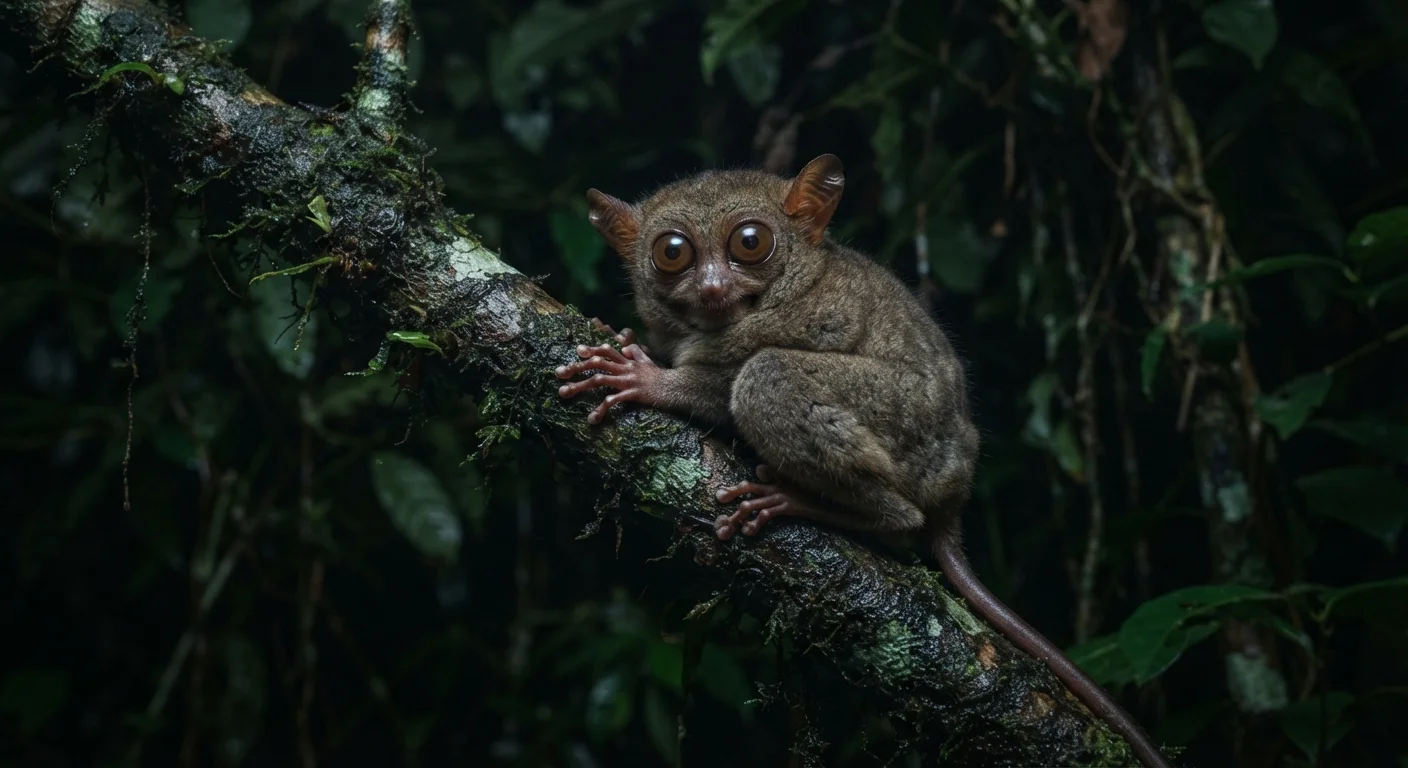
Rod photoreceptors, which detect light intensity rather than color, are densely packed in nocturnal retinas. Tarsiers - small Southeast Asian primates - have evolved eyes so large relative to their skull that they cannot rotate them and must turn their entire head, much like owls. Owls themselves have tubular rather than spherical eyes, maximizing light-gathering area while keeping the skull lightweight for flight.
Hearing, Smell, and the Acoustic World After Dark
When vision is limited, other senses compensate with remarkable precision. Many nocturnal mammals have evolved disproportionately large external ears - called pinnae - that funnel sound waves toward sensitive inner ear structures. The long-eared bat's ears can exceed the length of its own body, allowing it to detect the faint rustling of a moth's wings against a leaf.
Bats represent the pinnacle of acoustic adaptation. Echolocation - the emission of ultrasonic pulses and the neural processing of returning echoes - allows many bat species to navigate complex environments and detect prey with sub-millimeter spatial resolution. Different bat species have tuned their echolocation to specific ecological contexts: some emit long, constant-frequency calls suited to open spaces; others use frequency-modulated sweeps to locate insects among cluttered vegetation. The broader landscape of animal communication reveals how these signals also serve social functions within bat colonies.
Olfaction is equally critical in the dark. Rodents, mustelids, and many marsupials rely heavily on scent both to locate food and to interpret their social environment. The star-nosed mole, while not strictly nocturnal, exemplifies extreme tactile-olfactory specialization: its 22-tentacled nose contains more sensory receptors per square centimeter than almost any known mammalian structure.
Observing Nocturnal Animals Responsibly
Red-filtered flashlights are far less disruptive to nocturnal wildlife than standard white torches, as most mammals have limited sensitivity to long-wavelength red light. Keeping noise minimal and movement slow near foraging areas significantly reduces the likelihood of disturbing natural behavior. Always check local regulations before using any artificial light in wildlife reserves.
Threats to the Dark: Light Pollution and Nocturnal Wildlife
The ecological integrity of night is increasingly compromised by artificial light. Light pollution - the skyglow from cities, streetlights, and industrial facilities - now affects an estimated 80% of the global population's view of the natural night sky, and its biological consequences extend far beyond astronomy.
For nocturnal animals, artificial light disrupts the environmental cues that regulate foraging, reproduction, and migration. Research has documented that light-polluted environments alter the movement patterns of large mammals, suppress the emergence of nocturnal insects, and interfere with the bioluminescent mating signals of fireflies. Sea turtle hatchlings navigating by the natural brightness of the ocean horizon are frequently disoriented by coastal development lighting, leading them inland rather than seaward.
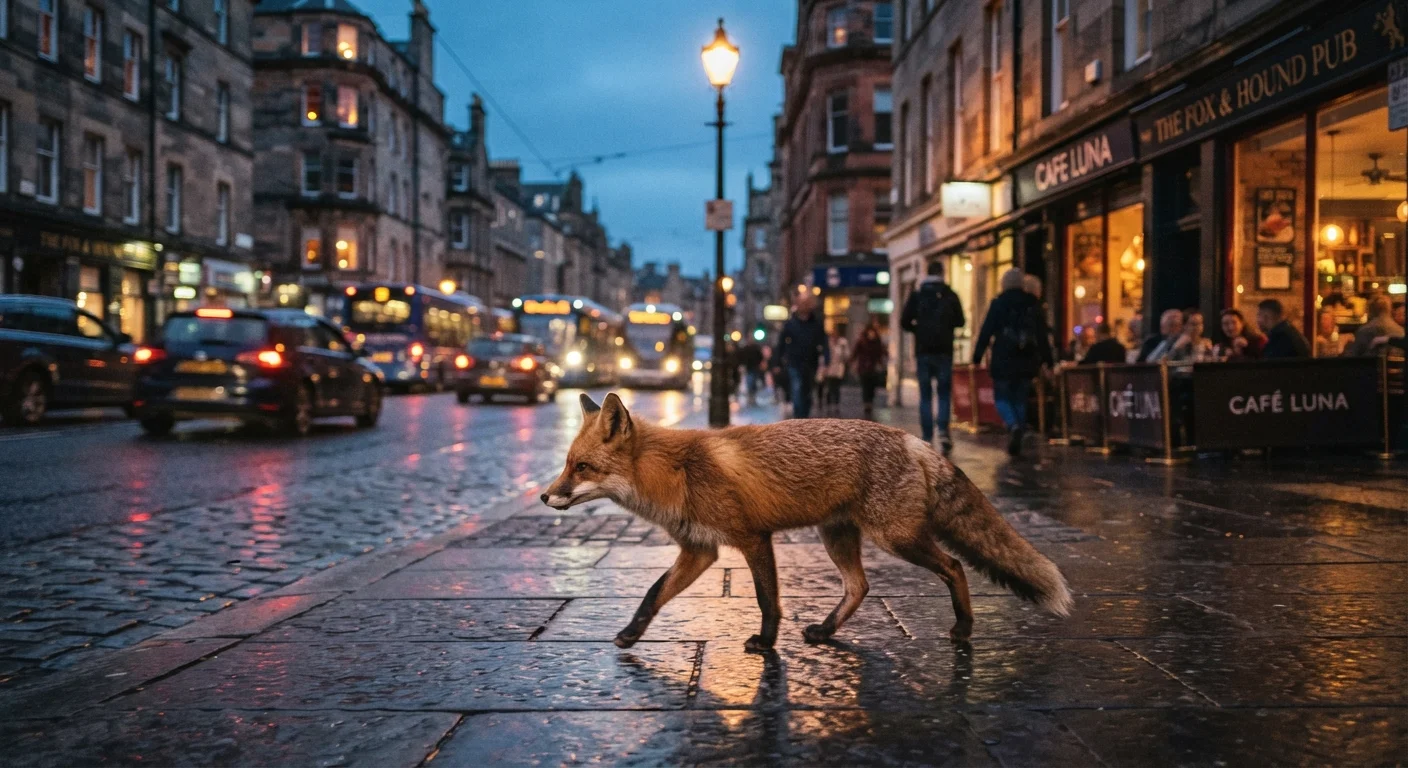
Urban environments are also reshaping nocturnal behavior in adaptive ways. Some species are shifting their activity windows in response to human disturbance - a phenomenon documented in wildlife behavioral shifts in urban environments. Understanding these pressures matters as much for conservation planning as any habitat protection effort. Responsible wildlife observation, including avoiding artificial illumination near known nocturnal habitats, remains one of the most direct ways observers can reduce their impact - principles outlined in our guide to responsible wildlife observation.