
How the Ocean Is Divided
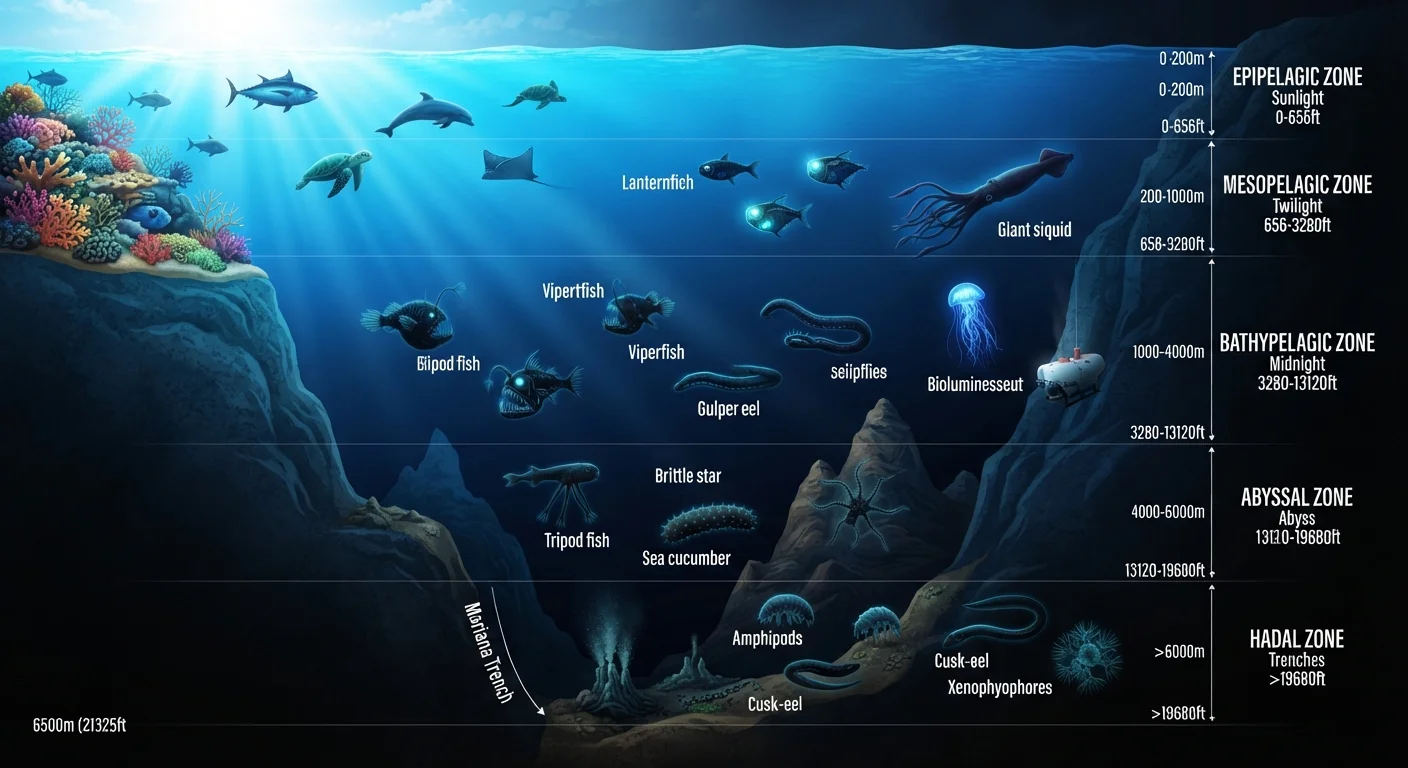
The ocean is not a uniform body of water. Scientists divide it into five primary vertical zones - sometimes called pelagic zones - defined by depth, light availability, pressure, and temperature. Each zone represents a distinct ecological environment, and the species within each have evolved highly specific adaptations to survive its particular conditions.
| Total ocean volume | Approximately 1.335 billion km³ (NOAA Ocean Facts) |
| Deepest known point | Challenger Deep, ~11,000 m (Mariana Trench) (NOAA / Scripps Institution of Oceanography) |
| Proportion of ocean unexplored | More than 80% (NOAA Ocean Exploration) |
| Primary production zone | Epipelagic (0-200 m) |
| Number of recognized pelagic zones | 5 (epipelagic, mesopelagic, bathypelagic, abyssopelagic, hadalpelagic) |
| Deepest vertebrate recorded | Snailfish (Pseudoliparis swirei), >8,000 m (Deep-Sea Research journal) |
Understanding these zones is foundational to marine biology and ecology. For a broader framework on how ecosystems function, see Understanding Ecosystems: A Field Guide for Curious Beginners.
The Five Ocean Zones and Their Inhabitants
Epipelagic Zone (0-200 m) - The Sunlit Zone
Sunlight penetrates fully here, enabling photosynthesis. This zone supports the ocean's highest biodiversity, including phytoplankton, jellyfish, sea turtles, dolphins, tuna, and most reef fish. The epipelagic zone is where the ocean's primary production - the base of the entire marine food web - occurs. Coral reefs, which sit within this sunlit layer, are among the most species-rich habitats on Earth.
Mesopelagic Zone (200-1,000 m) - The Twilight Zone
Light diminishes rapidly in this zone. Temperatures drop sharply, and pressure increases substantially. Animals here include lanternfish, hatchetfish, and the vampire squid. Many perform diel vertical migration - ascending to shallower waters at night to feed, then retreating to depth by day to avoid predators. Bioluminescence becomes increasingly common; explore the chemistry behind this phenomenon in our guide to how bioluminescence works.
Bathypelagic Zone (1,000-4,000 m) - The Midnight Zone
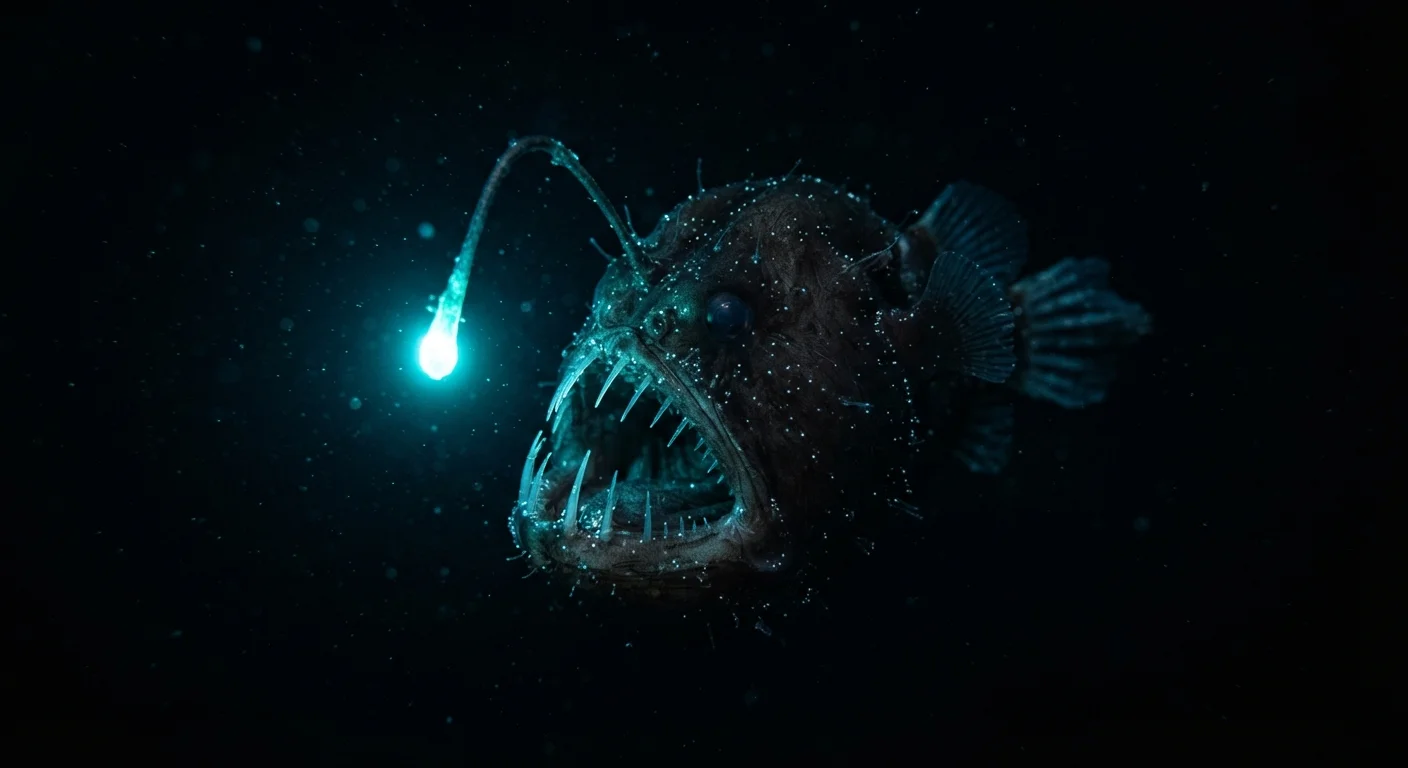
No sunlight reaches here. Water temperatures hover near freezing, and pressure exceeds 400 atmospheres. Yet life persists - anglerfish use bioluminescent lures to attract prey, and the giant squid roams these depths. Sensory adaptations replace vision as the primary survival tool, paralleling strategies seen in nocturnal animals on land.
Pelagic zone
The open-water column of the ocean, away from the seafloor and shore. It is subdivided into vertical layers based on depth and light penetration.
Bioluminescence
The production and emission of light by a living organism through a chemical reaction. It is widespread in deep-sea species and serves functions including predation, communication, and camouflage.
Diel vertical migration
The daily movement of marine organisms between deeper and shallower water. Animals typically ascend at night to feed in nutrient-rich surface waters and descend by day to avoid visual predators.
Marine snow
A continuous shower of organic material - dead cells, fecal pellets, and decaying matter - that drifts from upper ocean zones to the seafloor. It is the primary food source for many deep-sea organisms.
Chemosynthesis
A process by which certain bacteria produce organic compounds using chemical energy, rather than sunlight. It supports entire communities around hydrothermal vents in the deep ocean.
Hadal zone
The deepest oceanic layer, found only in trenches below approximately 6,000 meters. It is among the least explored environments on Earth, yet supports specialized life forms.
Abyssopelagic Zone (4,000-6,000 m) - The Abyss
The abyssal zone covers more of the Earth's surface than any terrestrial biome. Temperatures approach 2-3 °C, pressure reaches crushing extremes, and food is extraordinarily scarce. Species such as sea cucumbers, polychaete worms, and certain crustaceans subsist largely on "marine snow" - organic particles drifting down from upper layers. These animals exhibit some of nature's most extreme physiological adaptations, explored further in our article on remarkable animal adaptations.
Hadalpelagic Zone (6,000-11,000 m) - Hadal Trenches
Found only in oceanic trenches, this is the least explored environment on Earth. Despite pressures exceeding 1,000 atmospheres, amphipod crustaceans, snailfish, and specialized bacteria thrive. Snailfish have been recorded deeper than 8,000 m, making them among the deepest-dwelling vertebrates known to science.
>80%
Of the ocean remains unexplored
According to NOAA's Ocean Exploration program, the vast majority of the seafloor has never been directly observed or sampled.
1,000 atm
Pressure in hadal trenches
Pressures in the deepest ocean trenches exceed 1,000 atmospheres - more than 1,000 times the pressure at sea level.
~500 m
Nightly migration distance for mesopelagic animals
Many mesopelagic fish and invertebrates migrate several hundred meters vertically each night to access surface food sources.
Why Ocean Zone Ecology Matters
Each zone functions as an integrated ecological layer. Energy and nutrients flow downward through the water column - from photosynthesizing surface plankton to the scavengers of the abyss. Disruptions in the epipelagic zone, such as warming sea surface temperatures or altered upwelling patterns, cascade through every zone below.
The behavioral strategies animals use to navigate these zones - vertical migration, pressure tolerance, chemosensory hunting - reflect millions of years of evolutionary pressure. The study of animal behavior in marine contexts illuminates not just the ocean, but the broader principles of how life adapts to constraint.
Ocean zone ecology also underscores a core truth of conservation biology: protecting surface waters alone is insufficient. The health of deep zones is tied to the productivity and chemical balance of the ocean as a whole.
Ocean Zones Are Not Rigid Boundaries
The depth boundaries used to define ocean zones are scientific conventions, not sharp physical walls. In practice, temperature, salinity, and oxygen levels vary regionally, meaning zone boundaries can shift depending on geography and season. Polar regions, for instance, may have colder mesopelagic conditions at shallower depths than tropical seas.